
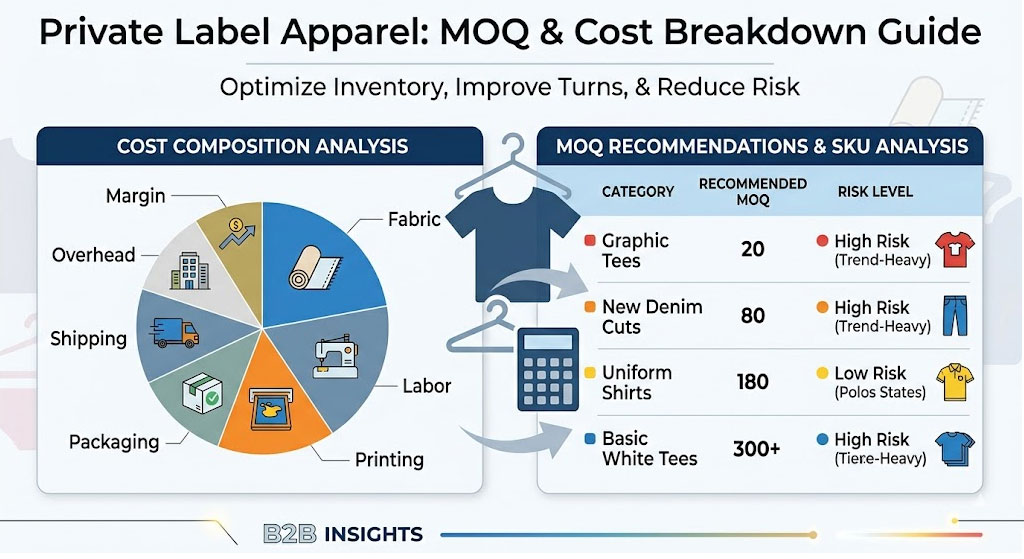
MOQ and cost breakdown planning helps private label apparel brands control inventory risk, set accurate pricing, and protect margins. This guide explains how to estimate an optimal MOQ by SKU, build itemized cost sheets (materials, trims, labor, decoration, packaging, and freight), and compare batch sizes to find the best unit-cost vs cash-flow balance.
You’ll also get practical tables you can reuse for forecasting, budgeting, and supplier negotiations—so you can launch faster with fewer surprises in production cost.
Planning a private label clothing order? Send us your product type, target quantity, materials, and target price. Our production team can help you estimate a practical MOQ and preliminary unit-cost range.
Request a Private Label Quote
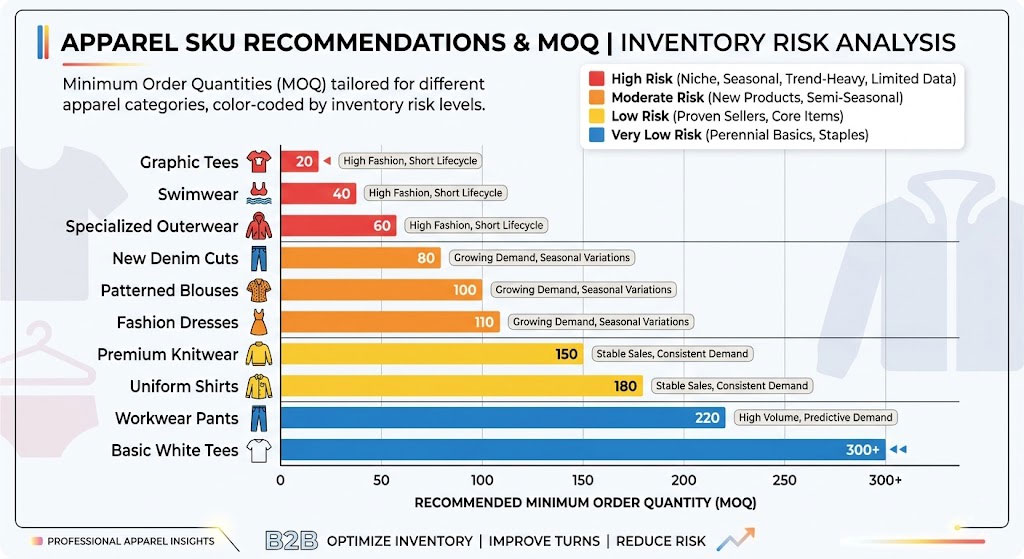
Calculate MOQ by SKU to Reduce Inventory Risk
Setting the right MOQ ensures efficient inventory management and prevents overproduction, which ties up capital unnecessarily.How to Calculate Optimal MOQ
- Analyze market demand for each SKU, including sizes, colors, and styles.
- Use sales forecasts to determine the ideal order quantity.
- Balance between avoiding stockouts and minimizing excess inventory.
SKU | Forecasted Sales | Suggested MOQ | Notes | Sell-through Target (%) | Reorder Lead Time (weeks) | Safety Stock (units) |
| Example Tee | 500 units | 300 units | Balance stock and cash flow | 80% | 4 | 100 |
| Hoodie Style A | 200 units | 150 units | Adjust based on seasonal demand | 75% | 6 | 50 |
Not sure how to divide your MOQ across colors and sizes? Send us your SKU plan, and we’ll help you identify a lower-risk production structure.
💡 Tip: Adjust the table as actual sales data comes in to fine-tune your MOQ planning.
Build an Itemized Cost Sheet to Protect Profit Margins
Understanding every component of your cost structure allows private label brands to price products accurately and increase profit.Key Cost Components
- Fabric & Trims: Main materials used per SKU
- Factory Processing / Labor: Sewing, cutting, and assembly
- Printing / Embroidery: Custom designs or logos
- Packaging & Shipping: Boxes, polybags, and freight
|
Cost Item |
Unit Cost | Quantity | Total Cost | Waste Al-lowance (%) | Overhead | Inspection |
Duties |
| Fabric | $5 | 1000 | $5000 | 5% | $200 | $50 | $100 |
| Labor | $2 | 1000 | $2000 | 0% | $150 | $30 | $0 |
| Printing | $1 | 1000 | $1000 | 0% | $50 | $20 | $0 |
| Packaging | $0.5 | 1000 | $500 | 0% | $25 | $10 | $0 |
| Shipping | $1 | 1000 | $1000 | 0% | $0 | $20 | $50 |
💡 Tip: Adjust unit costs or quantities in the sheet to see real-time impact on total cost per product.

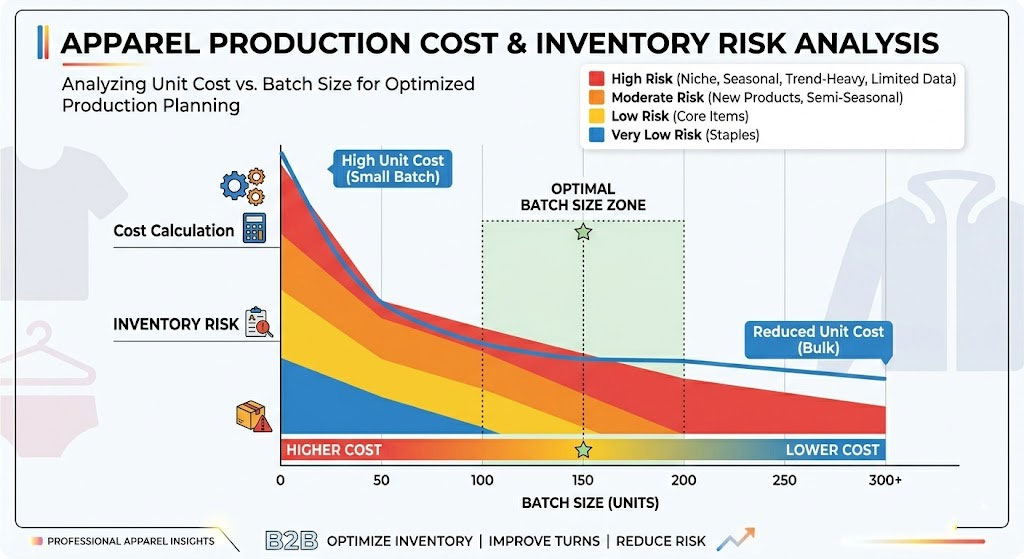
Compare Batch Sizes to Balance Unit Cost and Cash Flow
Smaller MOQs reduce upfront investment but can increase unit cost, while larger MOQs lower unit cost but raise inventory risk.Practical Table: MOQ vs Unit Cost Comparison
|
Batch Size |
Unit Cost | Total Investment | Inventory Risk | Gross Margin Estimate (%) |
Break-even Units |
| 100 units | $12 | $1200 | Low | 40% | 83 |
| 500 units | $9 | $4500 | Medium | 45% | 111 |
| 1000 units | $8 | $8000 | High | 50% | 133 |
💡 Tip: Use this comparison to determine the most cost-effective batch size for your brand.
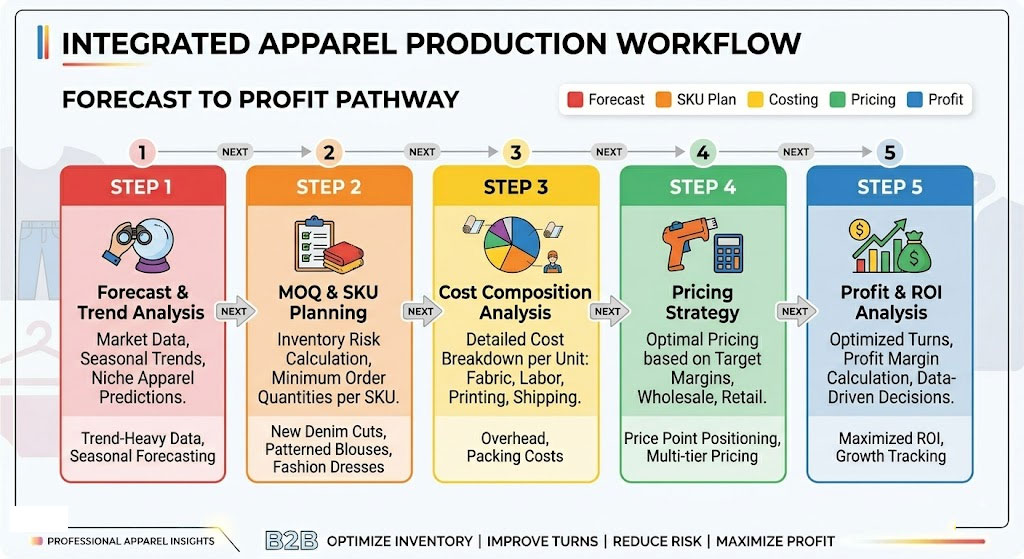
Use Cost Sheets to Improve Supplier Negotiation and Forecasting
Creating detailed cost sheets ensures visibility into every expense and helps with budgeting and reporting.- Include materials, labor, packaging, shipping, and any other indirect costs.
- Update sheets regularly to reflect changes in fabric pricing, labor rates, or shipping fees.
- Share cost sheets with your finance or sourcing team to maintain alignment.
FAQ — Private Label MOQ and Cost Questions
1.Can MOQ be adjusted by color or size?
Yes, most factories allow flexible MOQs for different colors and sizes to reduce inventory risk.2.How many samples are needed before bulk production?
Proto sample: 1–2 units Fit sample: 1–3 units Pre-production sample (PPS): 1 per size or variant before bulk3.Will small-batch production increase costs?
It usually slightly increases unit cost, but our rapid sample service and careful cost management minimize the impact.4.How do I calculate target FOB price based on retail price and margin?
FOB = Retail Price × (1 – Desired Margin%) ÷ Other Costs Factor (factor in shipping, duties, markup)5.What’s the typical MOQ for private label T-shirts vs hoodies vs jackets?
Typical MOQ:- T-shirts: ~100–300 units per design
- Hoodies: ~200–500 units
- Jackets: ~300–1000 units (depends on complexity & materials)
6.Can MOQ be split across sizes and colors in one style?
Yes, most factories allow splitting across sizes/colors, but some minimum per variant usually applies.7.How do decoration methods (screen print vs embroidery) change unit cost?
Screen print: lower cost for large runs, less durable on heavier fabrics Embroidery: higher cost per unit, especially for complex designs or small runs8.What hidden costs should be included (testing, QC, duties, payment fees)?
Fabric/testing certifications, QC/inspection fees, import duties & taxes, shipping, payment transaction fees, packagingConclusion
Planning MOQ and cost breakdowns is a crucial step for private label apparel brands. By analyzing market demand, breaking down costs, and comparing unit costs with MOQ, brands can:- Reduce inventory risk
- Optimize pricing and profit margins
- Accelerate time-to-market
Written by the Simmerui Sourcing & Production Team. We support private label apparel brands with MOQ planning, itemized costing, and production workflows from sampling to bulk. Our team helps brands build transparent cost sheets, evaluate material options, and set realistic lead times and QC checkpoints—so pricing decisions are based on measurable inputs, not guesswork.