
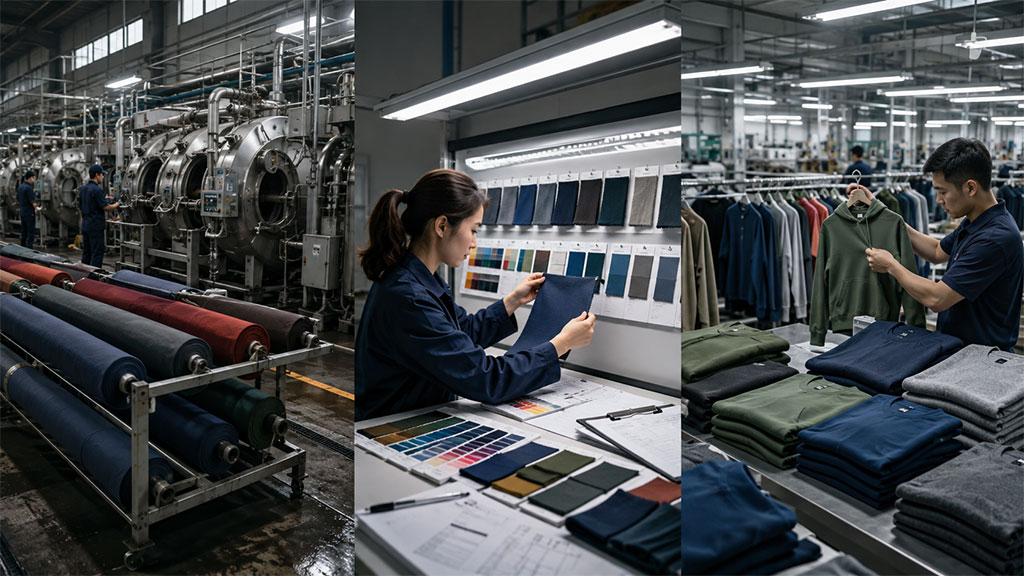
The garment manufacturing process includes three major production stages: cutting, sewing, and finishing. After fabric inspection and pattern preparation, manufacturers cut fabric panels according to approved specifications, assemble garments through sewing operations, and complete finishing procedures such as trimming, pressing, quality inspection, and packaging. A professional OEM apparel factory controls each stage with standardized workflows, skilled operators, and quality checkpoints to ensure consistent product quality, accurate sizing, and reliable bulk production for global fashion brands.
Why Dyeing Matters to Garment Quality
Color is one of the first characteristics customers notice when evaluating apparel. However, achieving the correct color is not simply a matter of selecting a Pantone reference or matching a fabric swatch. The dyeing process can affect:- Fabric appearance
- Color consistency
- Color durability
- Colorfastness
- Garment appearance after washing
- Shade consistency between production lots
- Compatibility between fabric and trims
| Problem | Potential Production Impact |
|---|---|
| Uneven color | Visible shade differences across fabric or panels |
| Color bleeding | Color migration during washing |
| Color transfer | Dye transfers through rubbing or contact |
| Fading | Loss of visual color intensity |
| Lot-to-lot variation | Inconsistent garments within the same order |
| Poor color matching | Fabric and trims appear visually inconsistent |
What Is the Dyeing Process in Apparel Manufacturing?
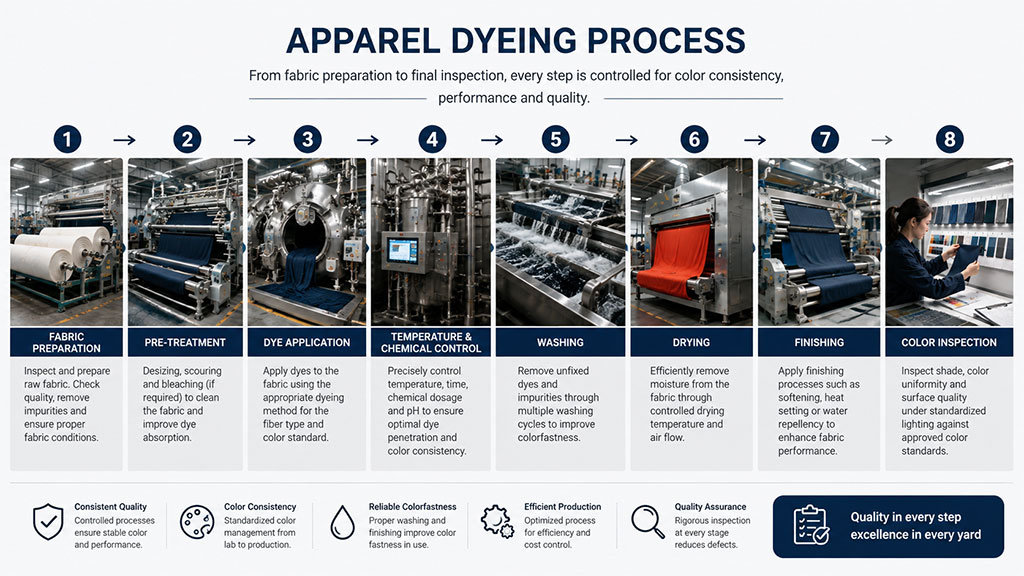
Dyeing is the process of adding color to textile fibers, yarns, or fabrics. The appropriate dyeing method depends on several variables, including:- Fiber composition
- Fabric construction
- Dye type
- Required color
- Fabric weight
- Intended garment application
- Fabric preparation
- Pre-treatment
- Dye application
- Temperature and chemical control
- Washing
- Drying
- Finishing
- Color inspection
Why Fiber Composition Matters
The same color reference does not automatically produce the same visual result on every fabric. For example, changing the fiber composition, fabric construction, or processing conditions can affect how the final fabric absorbs and presents color.This is why OEM manufacturers should confirm that the selected dyeing method is compatible with the approved fabric specification before bulk production begins.
Why Color Matching Is Critical for B2B Apparel Buyers
For a fashion brand, the approved color is part of the product specification.
Depending on the development process, the approved reference may be:
- Pantone color
- Lab dip
- Fabric swatch
- Digital color reference
- Approved production sample
Bulk production should then be compared against the approved reference.
Why Can Bulk Color Vary?
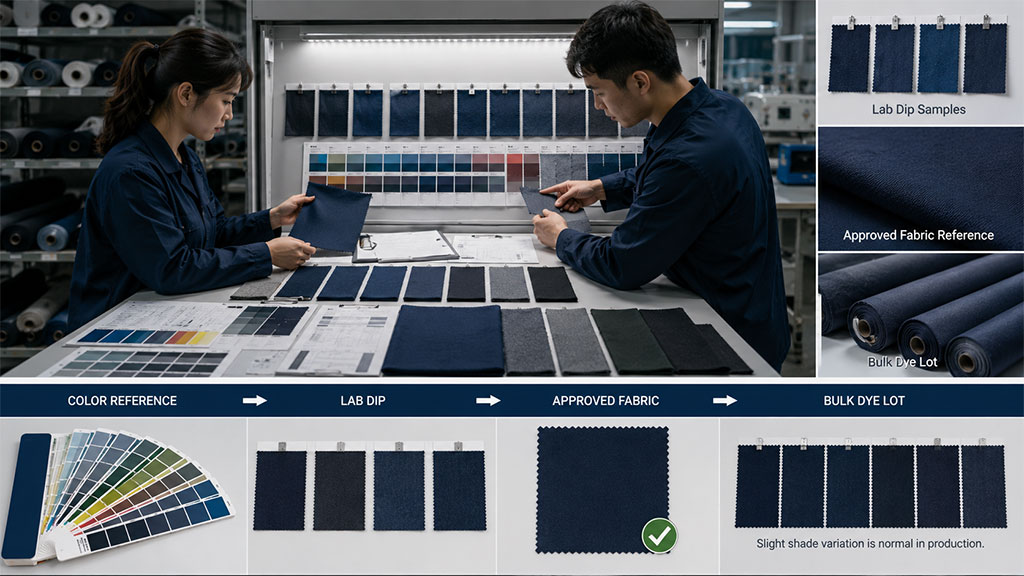
Even when a manufacturer uses the same color formula, production color can vary because of differences in:
- Fabric composition
- Dye concentration
- Dyeing temperature
- Processing time
- Water conditions
- Fabric pretreatment
- Finishing process
- Production batch
Therefore, professional apparel manufacturing requires a controlled color approval process before bulk production.
Recommended B2B Color Approval Chain
Buyer Color Reference → Lab Dip → Fabric Approval → Production Dye Lot → Shade Inspection → Bulk Production
This creates a traceable connection between what the buyer approved and what the factory produces.
What Is Colorfastness in Garment Manufacturing?
Colorfastness refers to a textile’s ability to retain its color when exposed to conditions such as:
- Washing
- Rubbing
- Perspiration
- Light
- Water
Good colorfastness helps a garment maintain an acceptable appearance during normal use and care.
Poor colorfastness can lead to:
- Fading
- Bleeding
- Staining
- Color transfer
- Uneven appearance
The appropriate colorfastness requirements depend on the garment’s fiber type, product category, intended market, use conditions, and care instructions.
For B2B buyers, this means there is no single colorfastness checklist that should automatically be applied to every apparel product.
Common Colorfastness Tests for Apparel
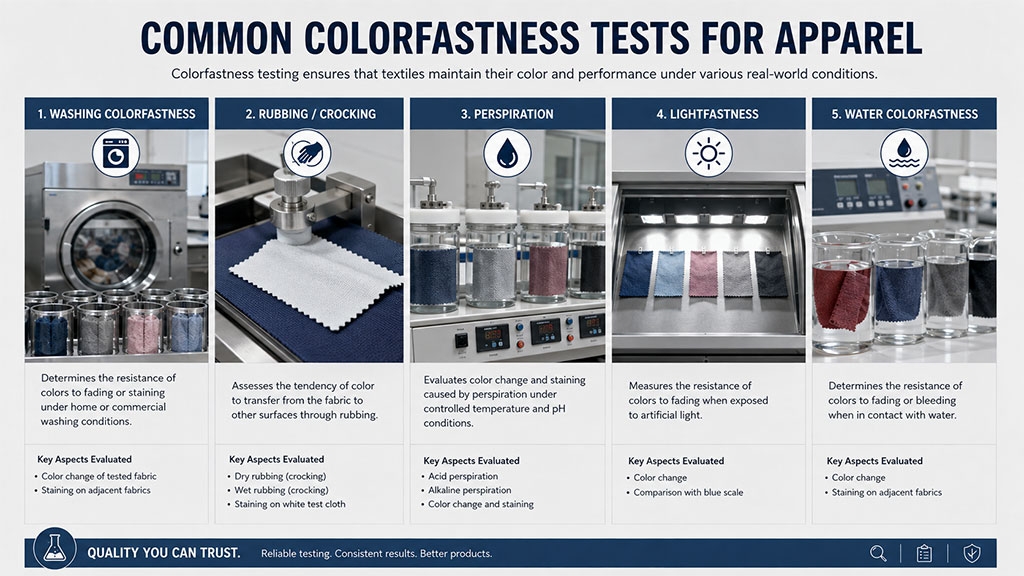
Different tests evaluate different forms of color exposure.
| Test | What It Evaluates | Typical Applications |
|---|---|---|
| Washing | Color change and color transfer during washing | T-shirts, hoodies, casualwear, children’s apparel, workwear |
| Rubbing / Crocking | Color transfer caused by rubbing | Dark garments, denim, dyed cotton, pigment-treated fabrics |
| Perspiration | Color stability under perspiration exposure | Sportswear, activewear, performance apparel |
| Light | Resistance to fading caused by light | Outdoor apparel, sportswear, workwear |
| Water | Color stability when exposed to water | Products where water exposure is part of use |
The source article specifically identifies washing, rubbing, perspiration, light, and water as common colorfastness evaluations.
1. Colorfastness to Washing
Washing tests evaluate how fabric color changes or transfers during laundering.
This is particularly important for:
Poor washing fastness can result in fading or staining of other garments.
2. Colorfastness to Rubbing
Also called crocking, this evaluates whether color transfers when the fabric is rubbed.
Both dry and wet rubbing conditions may be evaluated.
This can be particularly relevant to dark-colored garments, denim, dyed cotton, and pigment-treated fabrics.
3. Colorfastness to Perspiration
Perspiration testing evaluates color stability when fabric is exposed to perspiration.
It can be especially relevant to:
- Sportswear
- Performance apparel
- Activewear
- Summer clothing
For performance-oriented products, color stability should be considered alongside the garment’s other functional requirements.
4. Colorfastness to Light
Lightfastness measures resistance to fading caused by light exposure.
It can be particularly relevant to garments designed for:
- Outdoor use
- Sports
- Work environments
- Long-term sunlight exposure
5. Colorfastness to Water
Water testing evaluates color stability when textiles come into contact with water.
The appropriate testing program should be determined by the intended application and buyer requirements.
How Poor Dyeing Can Affect Finished Garments
A major B2B manufacturing problem is that dyeing defects may not become obvious during the initial visual inspection. A fabric can appear acceptable when first inspected but perform poorly during washing or rubbing tests.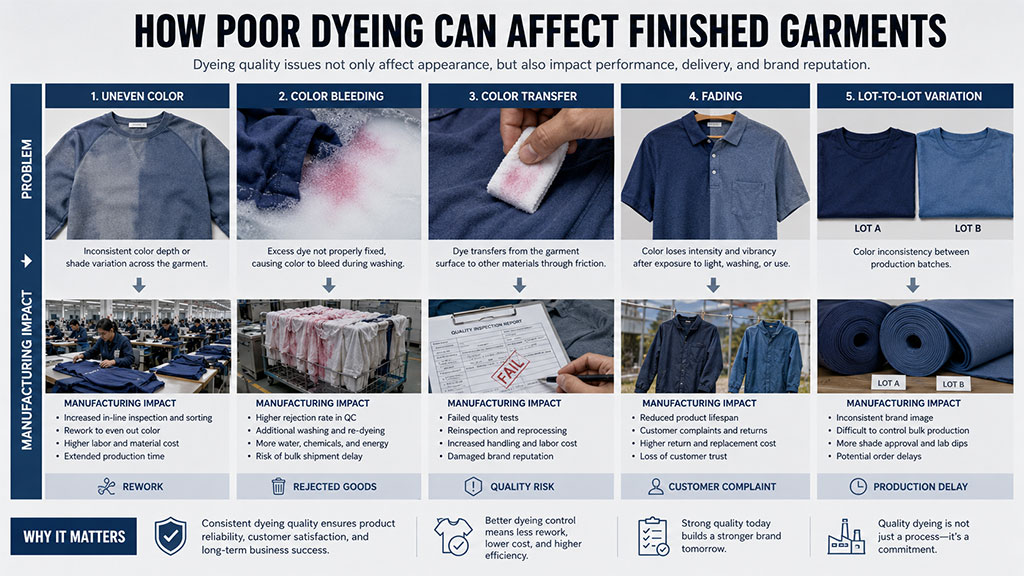
Problem 1: Uneven Color
Uneven dye penetration can create visible shade variation across fabric. After cutting, this variation can become particularly noticeable when different panels are assembled into one garment.Problem 2: Color Bleeding
Excess or poorly fixed dye may migrate during washing. This can affect the garment itself or other fabrics washed with it.Problem 3: Color Transfer
Color can transfer from one surface to another through rubbing or contact. This is particularly important for dark-colored fabrics and products exposed to repeated friction.Problem 4: Fading
Insufficient colorfastness can cause color intensity to decrease after washing or light exposure. For brands selling garments expected to maintain their appearance through repeated use, this can become a product-quality concern.Problem 5: Lot-to-Lot Variationg
Different fabric production batches may show noticeable shade differences. For large apparel orders, these problems can result in:- Rework
- Rejected goods
- Production delays
- Customer complaints
- Additional production costs
OEM Dyeing Quality Control Before Bulk Production
The best time to identify color problems is before bulk production begins. A structured OEM workflow can include five key control stages.| QC Stage | Key Action | Buyer Decision |
|---|---|---|
| 1. Color Reference | Confirm approved color standard | Approve reference |
| 2. Lab Dip | Develop and submit color sample | Approve/revise |
| 3. Fabric Testing | Evaluate relevant performance | Confirm requirements |
| 4. Bulk Shade Control | Compare production fabric with standard | Accept/reject |
| 5. Production Inspection | Check fabric and garments | Release or correct |
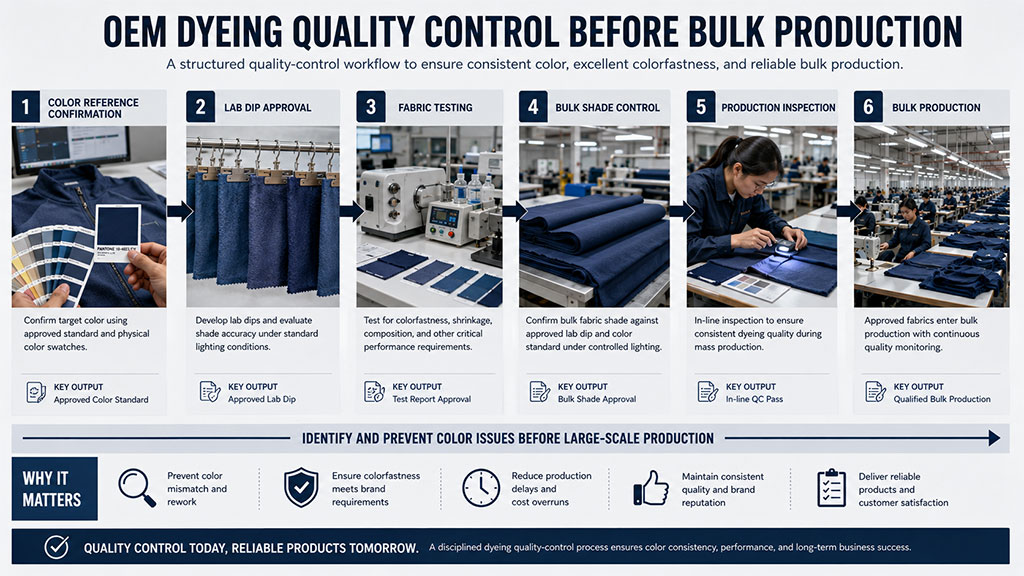
Step 1: Confirm the Color Reference
The buyer and manufacturer should agree on the exact approved color reference.
Avoid relying solely on verbal descriptions such as:
- Dark blue
- Warm grey
- Forest green
- Off-white
A standardized or physical reference creates a more reliable production target.
Step 2: Approve the Lab Dip
For dyed fabrics, a lab dip or color sample can be submitted for buyer approval.
This provides an opportunity to identify color differences before bulk fabric production.
Step 3: Test the Actual Fabric
The selected production fabric should be evaluated against relevant performance and colorfastness requirements.
Testing requirements should reflect the actual product rather than an unrelated standard checklist.
Step 4: Control Bulk Shade
Production fabric should be compared with the approved color standard.
Different dye lots should also be identified and tracked.
Step 5: Conduct Production Inspection
Fabric and finished garments should be inspected for:
- Shade consistency
- Visible color defects
- Panel-to-panel differences
- Other production defects
This approach reduces the chance of discovering major color problems only after garments have already been manufactured.
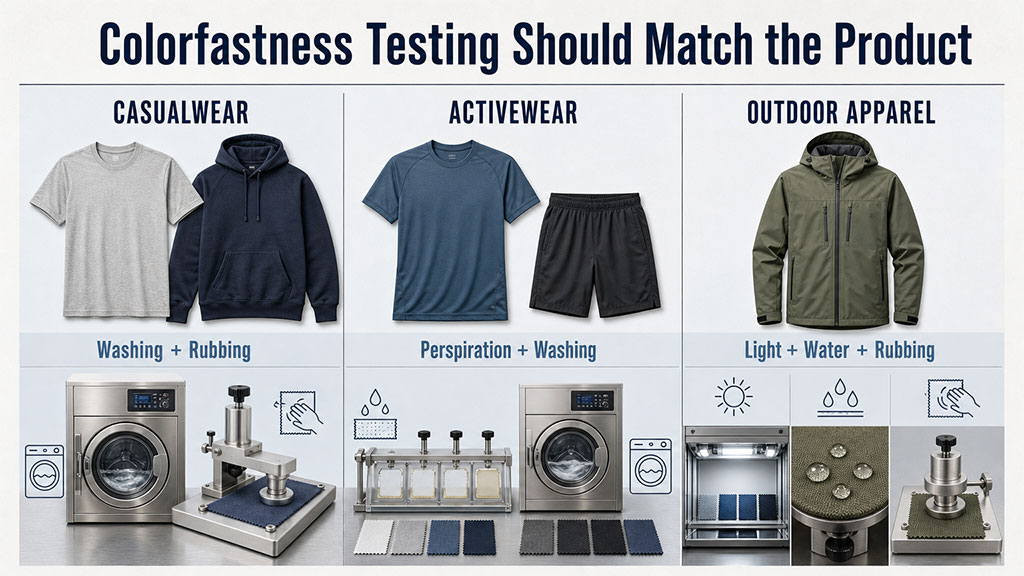
Colorfastness Testing Should Match the Product
Not every garment requires exactly the same testing program.
The appropriate testing requirements depend on:
- Fabric composition
- Garment category
- Intended use
- Target market
- Care method
- Buyer specifications
Product-Specific Testing Considerations
| Product Type | Color Control Priority |
|---|---|
| Basic casualwear | Washing and rubbing performance |
| Activewear | Perspiration and washing resistance |
| Outdoor apparel | Light, water, rubbing, and other relevant requirements |
| Dark-colored apparel | Rubbing and washing performance |
| Denim | Rubbing and washing performance |
The purpose is not to maximize the number of tests.
The objective is to select testing that reflects the actual product risk.
What B2B Apparel Buyers Should Ask Manufacturers
Before approving bulk production, purchasing and product-development teams should ask manufacturers specific questions.
Color Approval
- Has the final color reference been approved?
- Is there an approved lab dip or fabric standard?
- How is production shade variation controlled?
Testing
- Which colorfastness tests are required?
- Were the tests performed on the actual production fabric?
- Are test reports available?
Production Control
- How are different dye lots identified?
- How is shade consistency monitored?
- What happens if production fabric falls outside the approved tolerance?
Documentation
Buyers should maintain:
- Approved color standards
- Lab dips
- Fabric specifications
- Test reports
- Production inspection results
Clear documentation helps purchasing, production, and QC teams work from the same approved specifications.
Three Illustrative OEM Scenarios: Where Dyeing Risks Appear
The following scenarios are illustrative manufacturing situations, designed to show how the QC framework can be applied. They are not presented as documented Simmerui customer cases.
Scenario 1: Dark-Colored Casualwear
Target Customer: Private-label apparel retailer
Product Application: T-shirts and casual tops
Key Risk: Color transfer and fading
A dark-colored casualwear program may require particular attention to washing and rubbing performance.
OEM Solution
The manufacturer establishes:
Approved Color Reference → Lab Dip → Fabric Testing → Dye-Lot Control → Production Shade Inspection
Production Value
The goal is to identify color-related risks before large quantities of finished garments are produced.
Scenario 2: Performance Activewear
Target Customer: Fitness startup
Product Application: Performance and activewear
Key Risk: Perspiration and washing exposure
For activewear, perspiration and washing resistance can be particularly relevant because garments may experience repeated exposure to sweat and laundering.
OEM Solution
The testing program is aligned with:
- Actual fabric composition
- Product use
- Care method
- Buyer specifications
Production Value
Rather than applying the same testing program to every garment, the manufacturer connects testing to the actual product requirements.
Scenario 3: Outdoor Apparel Collection
Target Customer: Outdoor apparel brand
Product Application: Outdoor garments
Key Risk: Light, water, rubbing, and lot consistency
Outdoor garments may face greater exposure to environmental conditions.
OEM Solution
The production workflow can prioritize relevant colorfastness testing while maintaining strict shade control between production lots.
Production Value
The objective is to ensure that the finished garment continues to meet agreed quality requirements throughout expected use and care.
How OEM Manufacturers Reduce Dyeing-Related Production Risks
B2B buyers can reduce production risk by establishing controls early.
1. Approve Before Bulk
Never rely only on verbal color descriptions.
Use an approved physical or standardized color reference.
2. Test the Actual Fabric
Where possible, testing should be performed on material representative of the actual production fabric.
3. Define Requirements Early
Colorfastness requirements should be discussed during product development rather than after production.
4. Control Production Lots
Different dye lots should be tracked and inspected to reduce shade variation.
5. Maintain Documentation
Keep:
- Approved references
- Test results
- Fabric specifications
- Production inspection records
This creates a more traceable production history for future orders.
6. Work With an Experienced OEM Manufacturer
A manufacturer with established fabric sourcing, testing, QC, and production procedures can help identify potential problems earlier.
Dyeing Quality Affects More Than Appearance
Dyeing quality is not simply an aesthetic issue.
It can influence:
- Product durability
- Customer satisfaction
- Appearance after washing
- Brand consistency
- Return rates
- Quality claims
- Production costs
For B2B brands, a garment that looks correct when it leaves the factory is not necessarily sufficient.
The product should continue to meet agreed quality requirements throughout its expected use and care cycle.
That is why:
Dyeing Control + Colorfastness Testing + Production QC
should operate as an integrated quality management system.
Recommended OEM Quality Timeline
A practical color-control workflow can be organized around the product-development timeline:
| Production Stage | Color & Quality Action |
|---|---|
| Product Development | Define color and performance requirements |
| Fabric Development | Confirm fabric composition and specification |
| Lab Dip Stage | Develop and approve color |
| Pre-Production | Confirm testing requirements |
| Bulk Fabric Production | Track dye lots and monitor shade |
| Garment Production | Inspect fabric and finished garments |
| Final QC | Verify agreed quality requirements |
| Future Orders | Reference previous approved documentation |
The key principle is simple:
Do not wait until final inspection to discover a color problem.
The earlier color and colorfastness risks are controlled, the more opportunities the production team has to correct them before they affect a large order.
Why Dyeing Control Matters to OEM and Private Label Brands
For OEM and private-label apparel, fabric quality is directly connected to finished-garment quality.
Color information may need to move through several teams:
Buyer → Product Development → Fabric Supplier → Dyeing Factory → Production Team → QC Team
When approved color information is clearly communicated across these teams, the risk of inconsistent production can be reduced.
This becomes particularly important when a collection includes:
- Multiple colors
- Multiple fabrics
- Multiple dye lots
- Large production quantities
- Repeat production orders
The original production framework emphasizes coordination between buyer, product development, fabric, dyeing, production, and QC functions.
FAQ: Dyeing and Colorfastness in Garment Manufacturing
1. What is colorfastness in textile manufacturing?
Colorfastness is a textile’s ability to resist unacceptable color change or color transfer when exposed to conditions such as washing, rubbing, perspiration, water, or light. For apparel buyers, colorfastness is important because a garment may look correct when it is first produced but change during normal use or care. The appropriate requirements depend on factors such as fiber composition, garment category, intended use, target market, care method, and buyer specifications. Therefore, colorfastness should be considered during product development and quality planning rather than treated only as a final inspection issue.2. Why is colorfastness important for garments?
Good colorfastness helps garments maintain an acceptable appearance during normal use and care. Poor colorfastness can result in:- Fading
- Bleeding
- Staining
- Color transfer
- Uneven appearance
3. What are the most common colorfastness tests?
Common colorfastness evaluations include:- Washing
- Rubbing
- Perspiration
- Light
- Water
4. How can apparel manufacturers control color consistency?
Manufacturers can control color consistency through a combination of:- Approved color references
- Lab dips
- Controlled dyeing processes
- Fabric inspection
- Dye-lot tracking
- Bulk shade checks
- Production QC
5. Should colorfastness be tested before bulk production?
Yes. Relevant colorfastness requirements should be confirmed and tested before bulk production whenever possible. Testing before bulk production provides an opportunity to identify potential problems before large quantities of garments have been manufactured. For B2B buyers, the testing program should reflect the actual fabric, product category, intended use, care method, target market, and buyer specifications. This approach can help reduce the risk of discovering significant color-performance problems after production has already progressed.6. Can different fabric batches have different colors?
Yes. Even when the same color specification is used, differences in fabric composition, dyeing conditions, processing, finishing, or production batches can result in shade variation. This is why production lot control and shade inspection are important for large apparel orders. Manufacturers should identify different dye lots and compare production fabric with the approved color reference. For brands placing repeat orders, maintaining historical color approvals and production records can also help create a more consistent reference for future manufacturing.7. What should B2B buyers request from an apparel manufacturer?
Buyers should request or confirm:- Approved color references
- Lab dips where applicable
- Fabric specifications
- Relevant colorfastness requirements
- Applicable test reports
- Production QC procedures
- Dye-lot tracking procedures
- Shade-control procedures
Final Takeaway: Dyeing and Colorfastness Are Part of Garment Quality
Dyeing and colorfastness are essential components of overall garment quality.
A successful apparel production process does not simply achieve the correct color.
It must also ensure that:
- The approved color is clearly defined
- Bulk production remains visually consistent
- Relevant colorfastness requirements are tested
- Dye lots are controlled
- Production QC identifies problems early
- Documentation supports future production
For B2B apparel buyers, the safest approach is to establish color standards early, approve samples before bulk production, define appropriate colorfastness testing, and maintain quality controls throughout manufacturing.
When these controls are integrated into the OEM production workflow, brands can reduce quality risks and achieve more consistent results across bulk orders and future production runs.
Looking for an OEM apparel manufacturing partner for your next collection?
Contact Simmerui to discuss your product requirements, fabric specifications, sampling needs, and production quality-control requirements.