
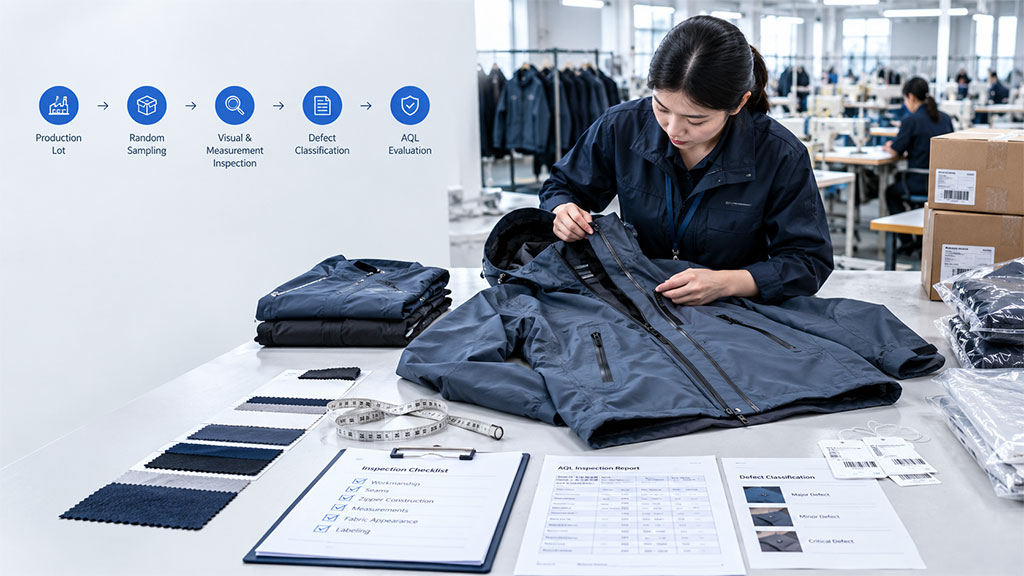
AQL inspection in apparel manufacturing helps B2B buyers evaluate whether a production lot meets agreed quality requirements without inspecting every garment. The process covers random sampling, visual and measurement checks, defect classification, and acceptance criteria. For OEM and ODM apparel orders, AQL works best as part of a broader quality-control system that includes approved samples, in-line QC, finished-garment inspection, and pre-shipment verification.
Introduction
For apparel brands, quality problems discovered after shipment can create much more than rework costs. Returns, customer complaints, retailer rejection, delivery delays, and brand reputation damage can all result from inconsistent production quality.This is why apparel quality inspection should be defined before bulk production begins. AQL provides a structured sampling method for evaluating a production lot. However, it is important to understand what AQL actually measures—and what it does not.
For buyers working with an OEM apparel manufacturer, the goal should not simply be to “pass AQL.” The goal is to establish clear product specifications and a repeatable QC process from sampling through final shipment.
What Is AQL Inspection in Apparel Manufacturing?
AQL, or Acceptable Quality Limit, is a sampling-based inspection method used to evaluate whether a production lot meets an agreed quality level.
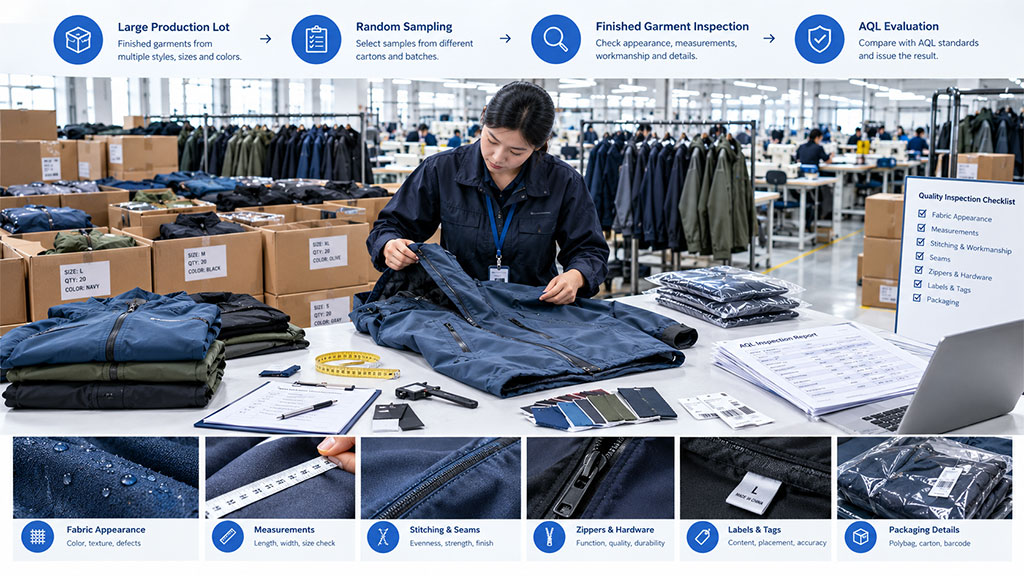
Instead of checking every garment, an inspector randomly selects a defined sample from the production lot. The garments are then checked against the buyer’s specifications, defects are classified, and the results are compared with the agreed acceptance criteria.
A typical process is:
Production Lot → Random Sampling → Visual & Measurement Inspection → Defect Classification → AQL Evaluation → Pass/Fail → Corrective Action
Why AQL Matters to B2B Apparel Buyers
A standardized inspection process gives buyers and manufacturers a common reference point for shipment decisions. It can also help reduce:- Customer complaints
- Returns and replacements
- Rework costs
- Delivery delays
- Retailer rejection
- Additional freight expenses
- Brand reputation risks
How AQL Inspection Works: 7 Key Steps
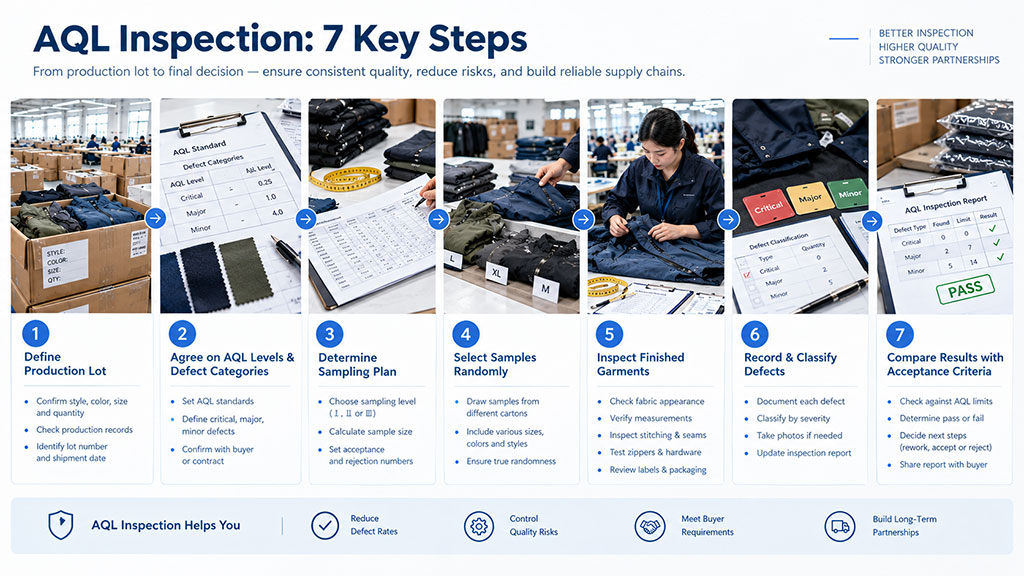
1. Define the Production Lot
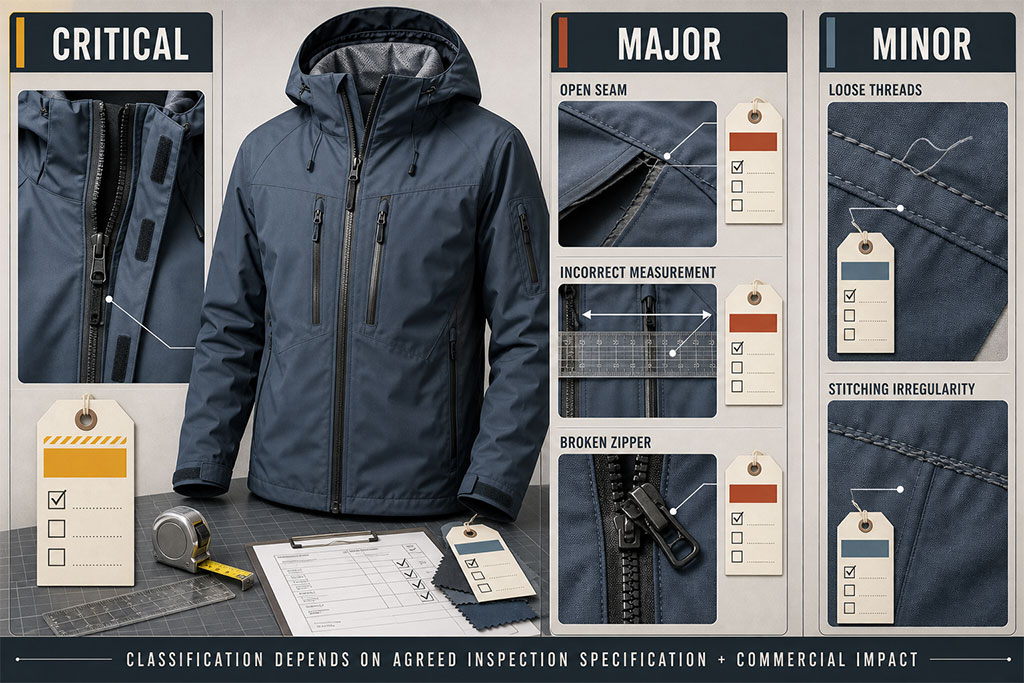
The first step is clearly defining the production lot by order, style, size/color grouping, or another agreed criterion. The lot size is important because it influences the inspection plan and sample size.2. Agree on AQL Levels and Defect Categories
Buyers and suppliers should agree on inspection requirements before bulk production. Defects are commonly grouped into three categories:| Defect Type | Typical Impact | Examples |
|---|---|---|
| Critical | Safety, regulatory, or serious functional risk | Dangerous components, serious compliance problems |
| Major | Significant effect on usability, appearance, or saleability | Open seams, incorrect measurements, broken zippers |
| Minor | Limited cosmetic or workmanship impact | Loose threads, minor stitching irregularities |
3. Determine the Sampling Plan
An AQL number alone does not define the entire inspection. The inspection plan should establish:- Lot size
- Inspection level
- Sample size
- AQL levels
- Defect classification
- Acceptance and rejection
- criteria
4. Select Samples Randomly
Samples should represent the production lot as fairly as possible.
Inspectors may select garments from different cartons, sizes, colors, pallets, or production areas. Checking only convenient cartons can produce a misleading picture of overall production quality.
5. Inspect Finished Garments
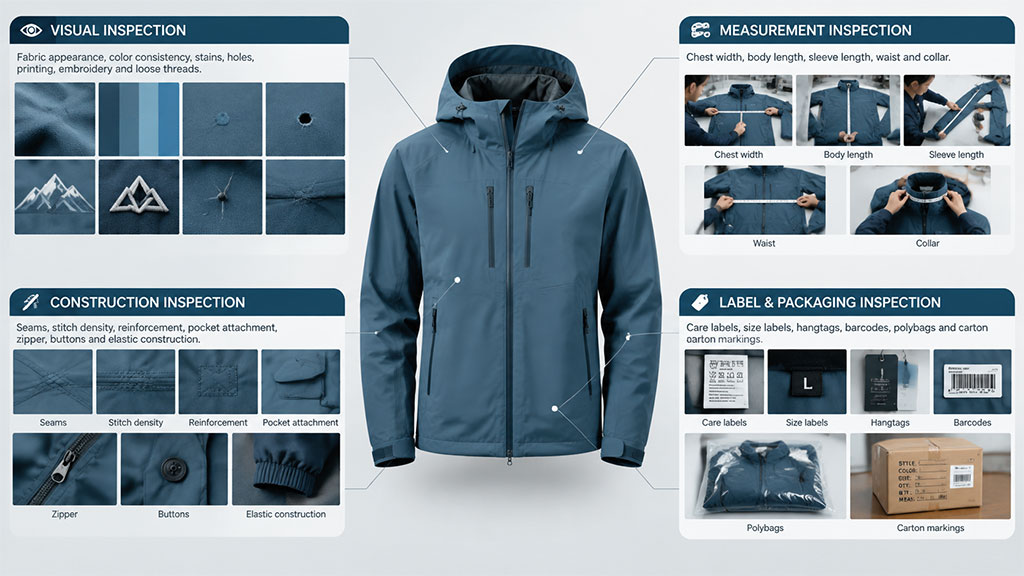
A professional garment quality inspection may cover several areas:
Visual inspection: fabric appearance, color consistency, stains, holes, printing, embroidery, loose threads, and sewing quality.
Measurement inspection: chest width, body length, shoulder width, sleeve length, waist, hem, and collar dimensions.
Construction inspection: seams, stitch density, reinforcement, pocket attachment, zippers, buttons, and elastic construction.
Label and packaging inspection: main labels, size labels, care labels, hangtags, barcodes, polybags, carton markings, and packing quantity.
For custom apparel, the approved sample, tech pack, and measurement specification should remain the primary product references.
6. Record and Classify Defects
Every detected defect should be documented and classified according to the agreed inspection standard.
The same physical issue may have different commercial significance depending on the product. A minor appearance issue on a premium technical jacket may matter more than the same issue on a basic promotional garment.
Clear defect definitions therefore reduce buyer-manufacturer disputes.
7. Compare Results With Acceptance Criteria
The inspection result is generally:
PASS: The inspected lot meets the agreed acceptance criteria.
FAIL: The number or severity of defects exceeds the agreed criteria.
A failed AQL inspection does not mean every garment in the order is defective. It means the inspected sample did not meet the agreed sampling criteria for acceptance.
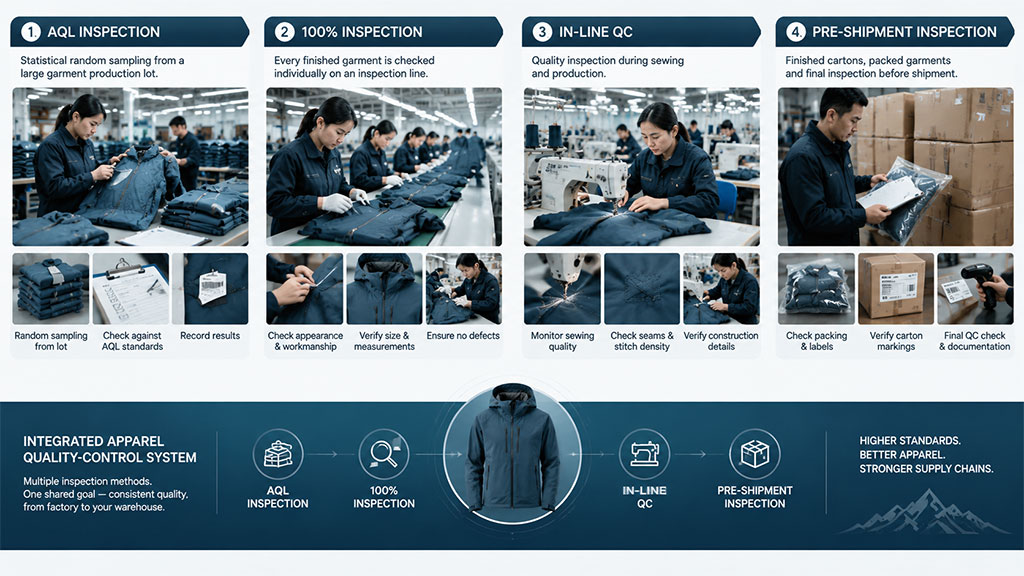
AQL Inspection vs. Other Apparel QC Methods
AQL should not be used as the only quality-control measure.| QC Method | Approach | Main Advantage | Limitation |
|---|---|---|---|
| AQL Inspection | Statistical sampling | Efficient for large lots | Does not inspect every unit |
| 100% Inspection | Every garment checked | Highest coverage | More time and cost |
| In-Line QC | Inspection during production | Finds problems early | Does not replace final inspection |
| Pre-Shipment Inspection | Finished goods inspection | Supports shipment decisions | Problems may be harder to correct late |
What Should Buyers Include in an AQL Inspection Specification?
Before bulk production, buyers should clearly document:Product Requirements
- Approved sample
- Tech pack
- Measurement chart
- Fabric specifications
- Color references
- Construction requirements
Defect Requirements
- Critical, major, and minor defect definitions
- Defect examples
- Measurement tolerances
Inspection Requirements
- Sampling standard
- Inspection level
- AQL levels
- Sample size
- Acceptance criteria
Packaging Requirements
- Folding method
- Polybag requirements
- Carton quantity
- Carton markings
- Labeling requirements
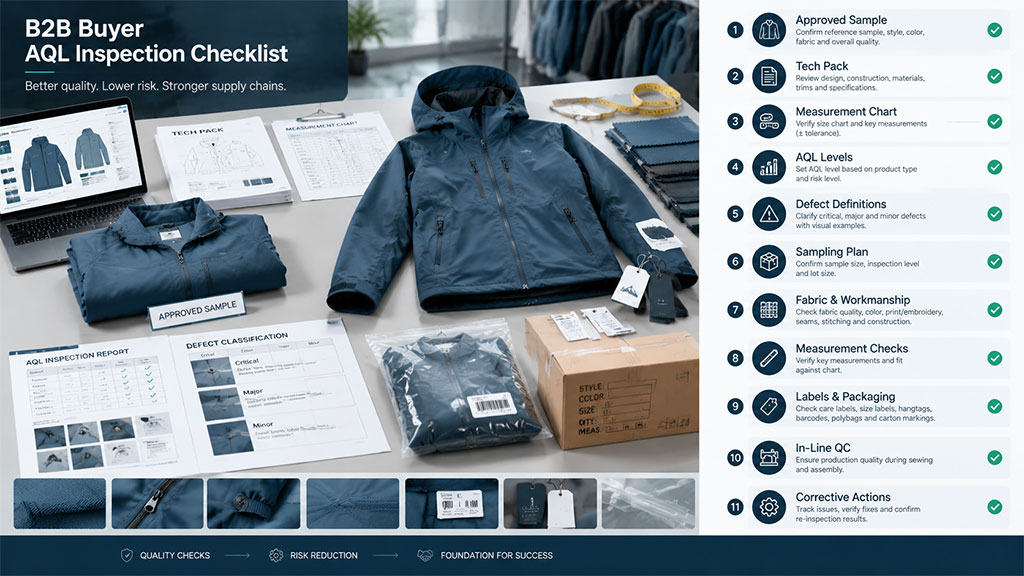
B2B Buyer AQL Inspection Checklist
Before approving an OEM apparel shipment, buyers should verify:
- ☐ Approved sample is controlled and available
- ☐ Tech pack and measurement chart are finalized
- ☐ AQL levels are agreed before production
- ☐ Critical/Major/Minor defects are clearly defined
- ☐ Sampling plan and acceptance criteria are documented
- ☐ Fabric and workmanship requirements are confirmed
- ☐ Measurements are checked against the approved specification
- ☐ Labels and packaging match the order requirements
- ☐ In-line QC has been performed
- ☐ Corrective actions are completed before final approval
This checklist helps shift quality control from a final inspection activity to a structured production-management process.
Common AQL Mistakes Apparel Buyers Should Avoid
Treating AQL as the Complete Quality Standard
AQL does not define every aspect of fabric quality, fit, construction, color, packaging, performance, or workmanship. These requirements must be documented separately.
Inspecting Too Late
Waiting until all production is completed can make corrective action more expensive. This is particularly important for outdoor apparel, waterproof garments, technical clothing, and complex constructions.
Changing Standards After Production
Inspection requirements should be agreed before bulk production. Changing AQL levels or defect definitions after production can create unnecessary commercial disputes.
How OEM Apparel Manufacturers Can Improve AQL Results
A strong OEM quality-control process should make final inspection more predictable.
Key practices include:
- Inspect raw materials before production.
- Confirm the approved sample.
- Control the tech pack.
- Perform first-piece inspections.
- Monitor sewing quality during production.
- Track recurring defects.
- Conduct measurement checks.
- Check packaging before final inspection.
- Perform internal pre-shipment QC.
- Correct root causes rather than repeatedly repairing individual garments.
This approach connects product development, production control, and final inspection into one quality-management process.
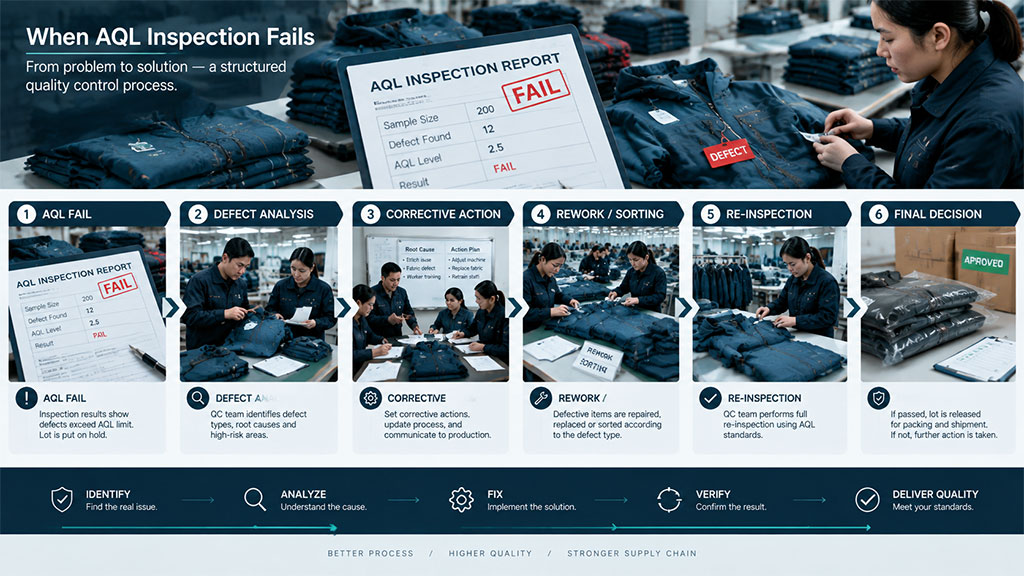
What Happens If an AQL Inspection Fails?
When a shipment fails, the buyer and manufacturer should follow the agreed corrective-action procedure.
Depending on the defect type and commercial agreement, actions may include:
Defect Analysis → Corrective Action → Rework/Sorting → Re-Inspection → Final Decision
Possible actions include repair, sorting, replacement, rework, root-cause analysis, or production-process adjustment.
FAQ: AQL Inspection in Apparel Manufacturing
1.Does AQL 2.5 mean 2.5% of garments can be defective?
No. AQL 2.5 should not be interpreted as simply allowing 2.5% defective garments. The actual decision depends on the lot size, sample size, sampling plan, and acceptance/rejection numbers.2.What defects are checked during apparel AQL inspection?
Inspectors may check fabric defects, sewing problems, stains, holes, measurements, construction, printing, embroidery, labeling, packaging, and functional issues.3.When should AQL inspection be performed?
AQL pre-shipment inspection is generally performed when a substantial portion of the order has been completed and packed, according to the buyer’s agreed procedure. In-line inspections can identify problems earlier.4.Is AQL inspection enough to guarantee apparel quality?
No. AQL is a sampling method, not a complete quality-management system. Effective apparel QC should also address materials, specifications, fit, construction, production processes, testing, packaging, and final inspection.5.Can an OEM apparel manufacturer perform AQL inspection?
Yes. An OEM manufacturer can conduct internal QC inspections, while buyers can also use an independent third-party inspection company when independent verification is required.Final Takeaway
AQL inspection gives B2B apparel buyers a structured way to evaluate production quality without checking every garment. But passing AQL should not be the entire quality strategy. The strongest approach combines approved product specifications, material control, in-line QC, finished-garment inspection, and AQL-based pre-shipment inspection. For OEM and ODM apparel sourcing, establishing these requirements before bulk production can reduce quality disputes, identify recurring production problems earlier, and create a more predictable path from sample approval to bulk shipment.Written by The Simmerui Apparel Manufacturing Team
Simmerui specializes in OEM and ODM apparel production for global B2B brands, with capabilities covering product development, fabric sourcing, sampling, quality control, and scalable manufacturing across outdoor apparel, performance wear, casual clothing, and private-label collections.
Planning an OEM apparel order? Share your product specifications, target quantity, and quality requirements to discuss a practical manufacturing and QC process.