
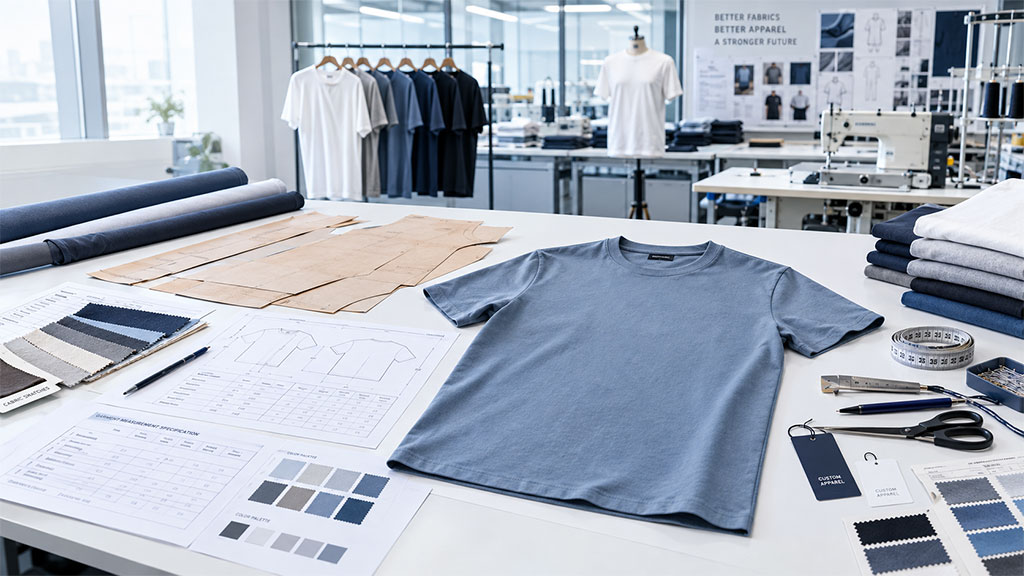
Custom T-shirt manufacturing involves much more than sewing finished garments. For a growing apparel brand, successful product development requires coordinated fabric sourcing, pattern development, sampling, fit evaluation, branding, quality control, and bulk production. In this case study, Simmerui follows the development of a custom T-shirt collection from the initial brand concept to production-ready garments. The process shows how a structured OEM workflow can help brands establish consistent specifications, reduce production risks, and prepare products for repeat orders and future collection expansion.
- Translate the T-Shirt Concept into Manufacturing Specifications
- Select T-Shirt Fabric for Fit, Feel, and Production Consistency
- Develop the Pattern and Build the First Prototype
- Refine Fit Through Sample Evaluation and Revision
- Integrate Branding and Custom Finishing
- Use the Approved Sample as the Pre-Production Standard
- Control Quality During Bulk T-Shirt Production
- Solve the Main Manufacturing Challenges
- Build a Scalable T-Shirt Manufacturing System
- Frequently Asked Questions
From a Brand Concept to a Production-Ready T-Shirt
A T-shirt may have fewer components than a technical jacket, but small production decisions can significantly affect the finished garment.
Fabric weight, fiber composition, fit, neckline construction, shrinkage, stitching, color, labeling, and decoration all influence the final product.
For a growing apparel brand, these details become especially important when moving from small product experiments to repeatable commercial production.
In this custom T-shirt manufacturing case study, the project followed a structured development process:
Brand Concept → Fabric Selection → Pattern Development → Prototype → Fit Evaluation → Revision → Branding → Pre-Production Approval → Bulk Production → Quality Control
The objective was not simply to manufacture the first order. It was to establish a reliable product specification that could be reproduced for future orders. This principle is central to professional OEM apparel development.
1. Translate the T-Shirt Concept into Manufacturing Specifications
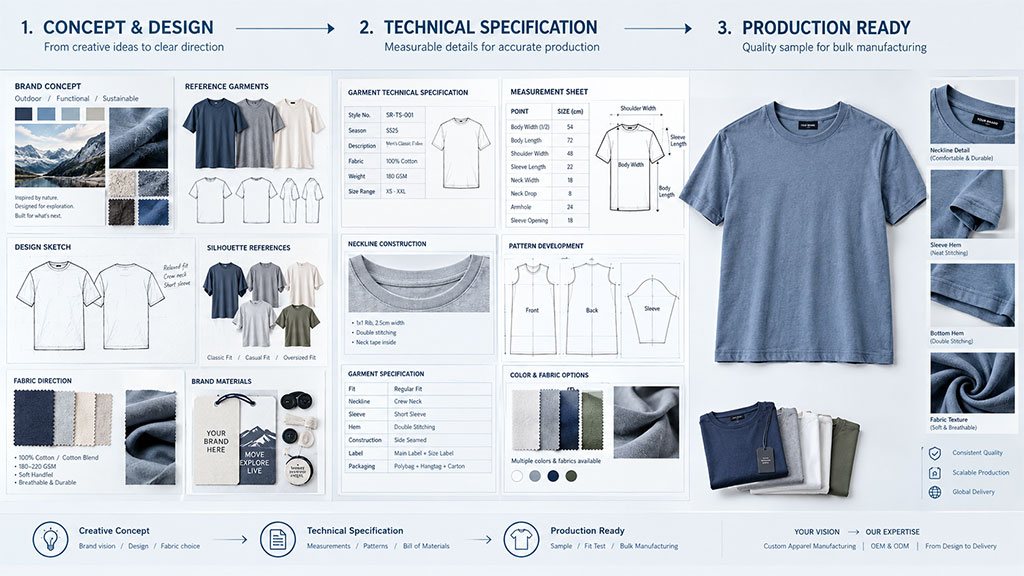
The first stage was to understand what the brand wanted the T-shirt to communicate and how the product should fit its target market.
The initial development information included:
- Reference garments
- Desired silhouette
- Target market
- Branding requirements
- Color direction
- Approximate measurements
The manufacturing team then translated these creative requirements into measurable production specifications.
Key areas included:
- Garment proportions
- Body width and garment length
- Sleeve length and shape
- Shoulder dimensions
- Neckline construction
- Fabric requirements
- Seam and stitching details
- Logo and label placement
- Color requirements
This step is critical because a design concept does not always contain enough information for direct bulk production.
Key principle: Terms such as “oversized,” “relaxed,” or “slightly longer” need to become measurable specifications before production. A repeatable product requires clear measurements and construction details rather than subjective descriptions.
Result: The brand concept was converted into a practical development specification that could be evaluated through sampling.
2. Select T-Shirt Fabric for Fit, Feel, and Production Consistency
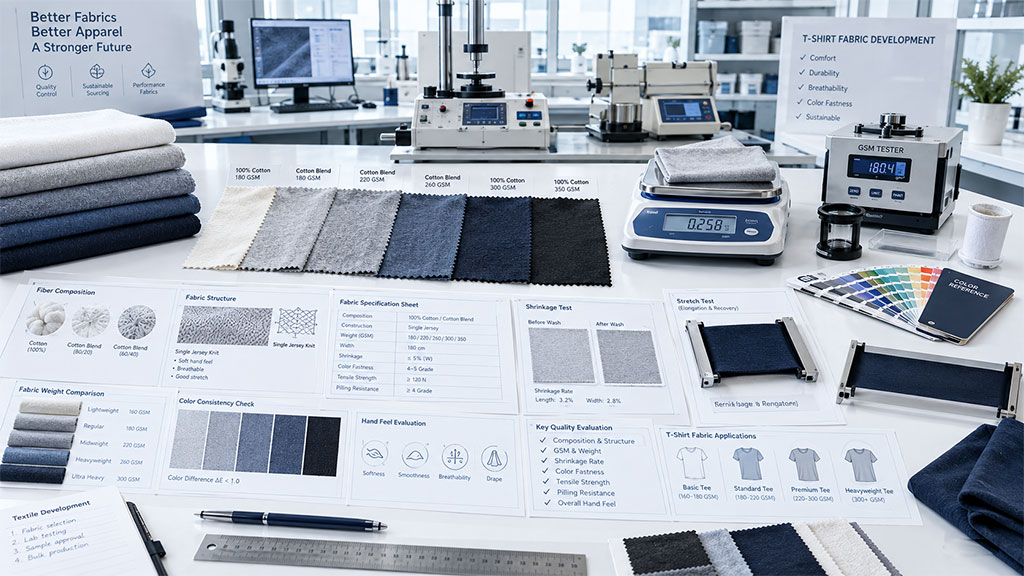
Fabric selection was one of the key decisions in the project.
The same T-shirt pattern can produce very different results depending on fabric weight, construction, composition, and finishing.
For custom T-shirt development, important fabric factors include:
| Fabric Factor | Manufacturing Impact |
|---|---|
| Fabric weight (GSM) | Influences structure, drape, and overall garment feel. |
| Fiber composition | Affects comfort, hand feel, durability, and production characteristics. |
| Fabric construction | Influences surface appearance, stretch, structure, and sewing behavior. |
| Shrinkage | Needs to be considered to maintain measurement consistency. |
| Colorfastness | Supports consistent color performance during use and care. |
| Hand feel | Helps achieve the intended product positioning and wearer experience. |
Fabric selection should also consider future sourcing.
A fabric may perform well during initial sampling but create problems later if the same specification cannot be sourced consistently. For growing brands, material continuity is therefore part of product development—not simply a purchasing decision.
Result: The fabric direction was selected according to the brand’s product positioning and target cost while considering future availability.
3.Develop the Pattern and Build the First Prototype
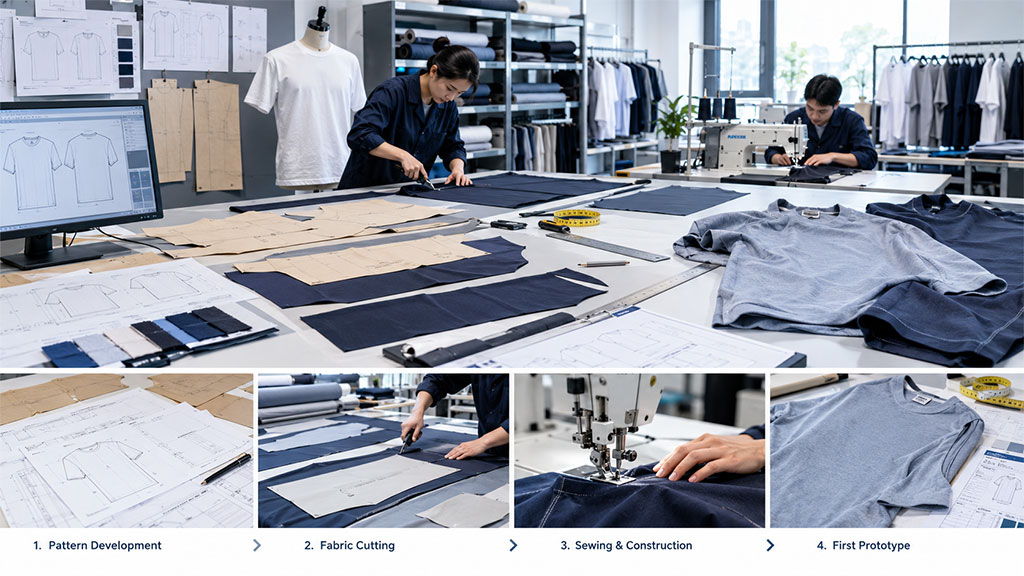
After establishing the basic fabric direction, the project moved into pattern development.
The first prototype translated the production specifications into a physical garment.
The workflow included:
The first prototype does not always need to be the final production sample.
Its purpose is to create a physical reference that allows the brand and manufacturing team to identify problems before bulk production.
This is particularly useful for growing brands because physical samples reveal issues that may not be obvious from drawings or written specifications.
Result: The initial concept became a measurable physical garment that could be evaluated and revised.
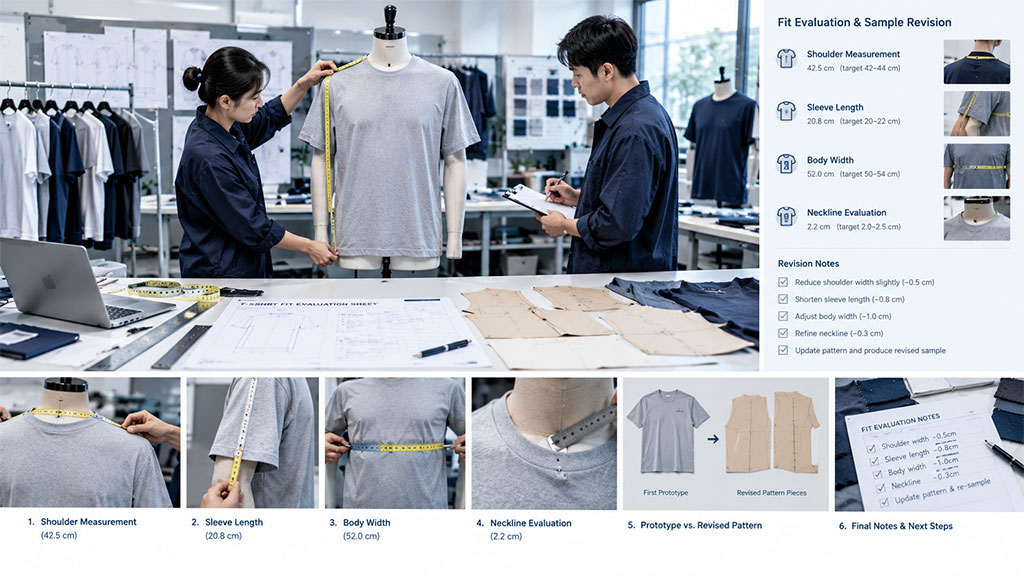
4. Refine Fit Through Sample Evaluation and Revision
Fit evaluation is a major part of custom T-shirt manufacturing.
Because a T-shirt has relatively few construction elements, small measurement differences can become highly visible.
The development team reviewed areas such as:
- Body width
- Garment length
- Sleeve proportion
- Shoulder dimensions
- Neck opening
- Rib construction
- Stitching details
After feedback was consolidated, the pattern was adjusted and another sample was developed.
The important principle is to convert subjective feedback into measurable changes.
Instead of simply requesting a “more relaxed” fit, for example, the development process needs to identify which measurements require adjustment.
This creates a direct connection between brand design intent and production specifications.
Result: The approved fit became a measurable reference that could be reproduced during bulk production.
5. Integrate Branding and Custom Finishing
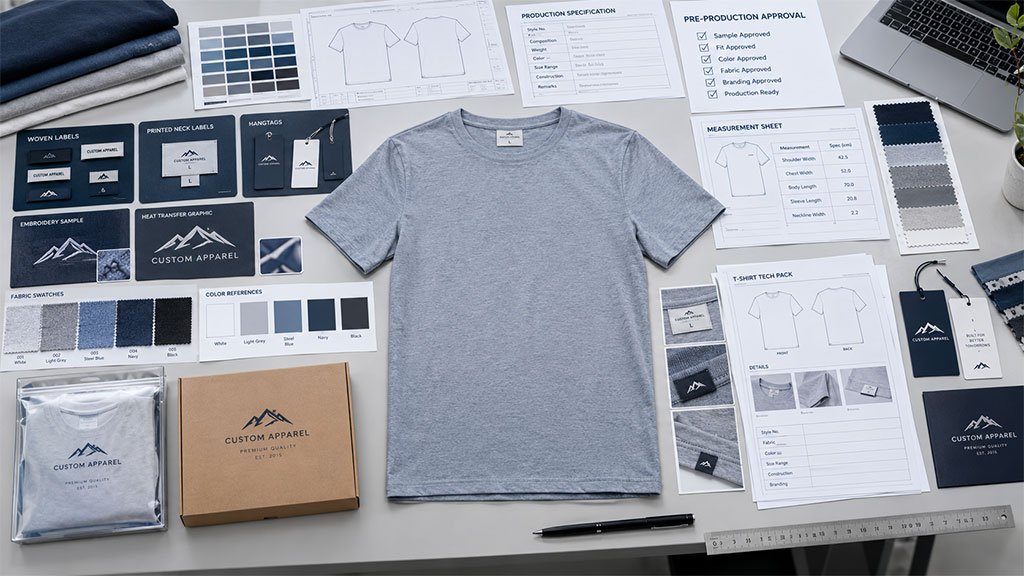
Once the basic garment construction was approved, brand-specific customization was integrated into the production specification.
Depending on the product requirements, custom T-shirts may include:
- Woven labels
- Printed neck labels
- Hangtags
- Embroidery
- Screen printing
- Heat transfer
- Custom packaging
Branding should not be treated as an isolated finishing step.
Placement, construction, production sequence, packaging, and final inspection can all be affected by branding requirements.
For this reason, the garment specification should document both the physical construction of the T-shirt and the required brand finishing details.
Result: The product specification incorporated the garment, branding, and packaging requirements into one manufacturing reference.
6. Use the Approved Sample as the Pre-Production Standard
Before bulk production, the final approved sample became the reference standard for manufacturing.
The production team confirmed:
- Fabric
- Color
- Measurements
- Garment construction
- Labels
- Decoration
- Packaging
The approved sample provided a physical benchmark for both production and quality control.
This is an important transition point between product development and bulk manufacturing. When the production team has a clearly approved reference, deviations can be identified against an established standard rather than interpreted from the original concept alone.
A properly documented approval process can therefore reduce the risk of differences between development samples and bulk garments.
7. Control Quality During Bulk T-Shirt Production
Once bulk production began, quality control focused on maintaining consistency with the approved specifications.
Fabric Inspection
The production team checked:
- Visible fabric defects
- Color consistency
- Material specifications
Measurement Inspection
Critical dimensions included:
- Chest width
- Body length
- Sleeve length
- Shoulder width
Sewing Inspection
The inspection process reviewed:
- Seam quality
- Stitch consistency
- Loose threads
- Neckline construction
Branding Inspection
Branding details were checked for:
- Label placement
- Print or embroidery quality
- Graphic positioning
Final Inspection
Finished garments were reviewed before packaging and shipment.
The purpose of structured inspection is to identify production problems before finished goods leave the factory.
8.Solve the Main Manufacturing Challenges
The case study highlights several recurring challenges in custom T-shirt manufacturing.
| Challenge | Manufacturing Solution |
|---|---|
| Converting Creative References into Specifications | Convert the concept into measurable specifications covering measurements, construction, fabric, branding, and sample references. |
| Maintaining Consistent Fit | Use physical samples and measurement feedback to refine body proportions, sleeves, shoulders, and neckline construction. |
| Preparing for Repeat Orders | Maintain a repeatable reference covering fabric, color, measurements, construction, branding, and packaging. |
| Multiple product variations may be required | Control variations through a standardized product development system. |
9. Build a Scalable T-Shirt Manufacturing System
The main lesson from this case study is that custom T-shirt manufacturing is a product development process, not simply a sewing process.
A structured OEM workflow connects:
Brand Concept → Fabric Selection → Pattern Development → Prototype → Fit Evaluation → Sample Approval → Bulk Production → Quality Control
Each stage influences the next.
If fabric specifications are unclear, the finished fit may change.
If measurements are not finalized, bulk production may become inconsistent.
If branding requirements are not documented, finishing details may vary.
For growing apparel brands, this integrated approach can create a stronger foundation for product development and supply-chain management.
From One T-Shirt to a Broader Product Line
Once a core T-shirt fit, fabric, and construction have been established, brands can use the product specification as a foundation for controlled product variations.
Potential extensions include:
- Different colorways
- Graphic T-shirts
- Embroidered T-shirts
- Heavyweight T-shirts
- Oversized T-shirts
- Long-sleeve T-shirts
- Matching sweatshirts
- Hoodies
The key is to maintain the core product specifications while controlling changes between different versions.
This allows a growing apparel brand to move from one successful product toward a more structured product line without losing manufacturing consistency.
Why OEM Product Development Matters for Growing Apparel Brands
As brands grow, manufacturing requirements often move beyond basic garment production.
An experienced OEM manufacturing partner may support multiple stages of the product lifecycle:
Product Development
- Design interpretation
- Pattern development
- Fabric sourcing
- Sampling
Production
- Material preparation
- Cutting
- Sewing
- Finishing
- Packaging
Quality Management
- Material inspection
- Inline inspection
- Measurement control
- Final inspection
Future Scaling
- Repeat production
- New colorways
- Product variations
- Additional apparel categories
For B2B apparel brands, this integrated approach can help connect product development, production control, and future scaling into a more consistent manufacturing system.
Conclusion: Turn a T-Shirt Concept into a Repeatable Product
A successful custom T-shirt manufacturing project requires coordination across design, materials, pattern development, sampling, fit, branding, production, and quality control.
The case study followed a structured path:
Concept → Fabric → Pattern → Prototype → Fit → Revision → Approval → Bulk Production → QC.
The objective was not only to manufacture the first order. The larger goal was to establish a repeatable product specification that can support future orders, new colorways, product variations, and broader apparel collections.
For growing brands, the right manufacturing process therefore needs to connect product development with scalable OEM production.
Frequently Asked Questions About Custom T-Shirt Manufacturing
1. What is custom T-shirt manufacturing?
Custom T-shirt manufacturing is the process of developing and producing T-shirts according to a brand’s requirements, including fabric, fit, measurements, colors, labels, graphics, construction, packaging, and production quantity.
2. What is the custom T-shirt development process?
A typical process includes:
Design Brief → Fabric Selection → Pattern Development → Prototype → Fit Review → Sample Revision → Approval → Bulk Production → Quality ControlThe number of development rounds depends on the product’s complexity.
3. What fabrics can be used for custom T-shirts?
Common options include cotton jersey, organic cotton, cotton-polyester blends, recycled cotton blends, and other knitted fabrics. The appropriate material depends on the desired weight, hand feel, performance, target price, and brand positioning.
4. What information does an apparel manufacturer need?
A manufacturer may need:
- Design drawings or reference images
- Tech pack, if available
- Measurements
- Fabric requirements
- Color specifications
- Branding requirements
- Expected order quantity
- Packaging requirements
If a brand does not have a complete tech pack, product development and sampling support may be available.
5. How many samples are needed before bulk T-shirt production?
The number varies according to the design and how closely the first prototype matches the requirements. Basic T-shirts may require fewer revisions, while complex fits, special fabrics, or customized construction can require additional sampling rounds.
6.What should a brand check before approving bulk production?
Brands should confirm:
- Fabric
- Color
- Measurements
- Fit
- Construction
- Label placement
- Print or embroidery
- Packaging
- Approved sample
The final approved sample should serve as a production reference.
7. Can an OEM manufacturer produce T-shirts in different colors and designs?
Once the core product specifications are established, manufacturers can typically develop different colorways, graphics, branding treatments, and related product variations according to the brand’s requirements and production capabilities.
8. Why is an approved sample important for bulk production?
The approved sample provides a physical reference for fabric, color, measurements, construction, branding, and other production details. It can therefore serve as a benchmark for manufacturing and quality control.
9. How can a T-shirt specification support future orders?
A documented specification covering fabric, color, measurements, construction, branding, and packaging can provide a repeatable manufacturing reference when the brand places future orders.
10. Can one T-shirt become the foundation for a larger apparel collection?
Yes. Once the core fit, fabric, and construction are established, the product can be extended into different colorways, graphics, weights, silhouettes, long-sleeve versions, sweatshirts, and hoodies, provided the changes are properly specified and controlled.
Written by the Simmerui Apparel Manufacturing Team.
We specialize in OEM and ODM apparel production for global B2B brands, providing integrated solutions across product development, fabric sourcing, sampling, quality control, and scalable manufacturing.
Our experience covers outdoor apparel, performance wear, casual clothing, and private label collections. We help brands reduce production risks, optimize costs, and build reliable long-term manufacturing partnerships.