
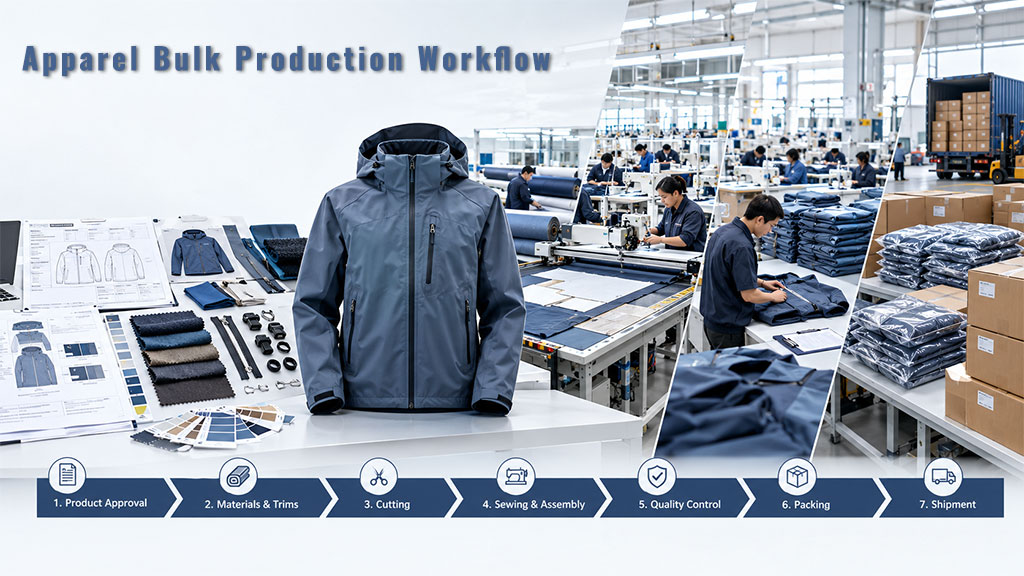
Apparel bulk production follows a controlled workflow that turns an approved production sample into hundreds or thousands of consistent garments. For B2B clothing brands, the process typically covers PPS approval, bulk material preparation, fabric inspection, spreading and cutting, sewing, branding, finishing, inline QC, final inspection, packing, and shipment. The main control points are material accuracy, cutting consistency, workmanship, quality inspection, packaging, and production scheduling.
A structured workflow helps OEM and ODM brands reduce rework, control production risks, and reproduce the approved product at scale.
What Happens During Apparel Bulk Production?
Bulk apparel production begins when product development moves from an approved Pre-Production Sample (PPS) into manufacturing.
The objective is not simply to produce a large quantity of garments. The factory must reproduce the approved sample consistently across:
- Fabric quality and composition
- Color and appearance
- Measurements and tolerances
- Sewing construction
- Functional details
- Branding
- Finishing
- Packaging
For B2B OEM and ODM orders, the production workflow can be summarized as:
PPS Approval → Material Preparation → Fabric Inspection → Relaxation & Spreading → Cutting → Sewing → Branding → Finishing → Inline QC → Final Inspection → Packing → Shipment
Each stage controls a different production risk.
Bulk Production Workflow at a Glance
| Production Stage | Main Activity | Key Control |
|---|---|---|
| PPS Approval | Confirm production standard | Approved PPS |
| Material Preparation | Prepare fabric, trims and labels | Material matching |
| Fabric Inspection | Check production rolls | Defects, color, GSM, shrinkage |
| Spreading & Cutting | Prepare and cut fabric panels | Alignment and cutting accuracy |
| Sewing | Assemble garments | Construction and workmanship |
| Branding | Apply logos and labels | Position and appearance |
| Finishing | Trim, press and clean | Final appearance |
| Inline QC | Inspect during production | Early defect detection |
| Final Inspection | Inspect finished lot | AQL and buyer standards |
| Packing | Pack and carton garments | Quantity and packaging accuracy |
| Shipment | Prepare delivery | Documents and carton verification |
1. Confirm the Approved PPS Before Bulk Production
Bulk production should begin only after the production standard has been clearly confirmed.
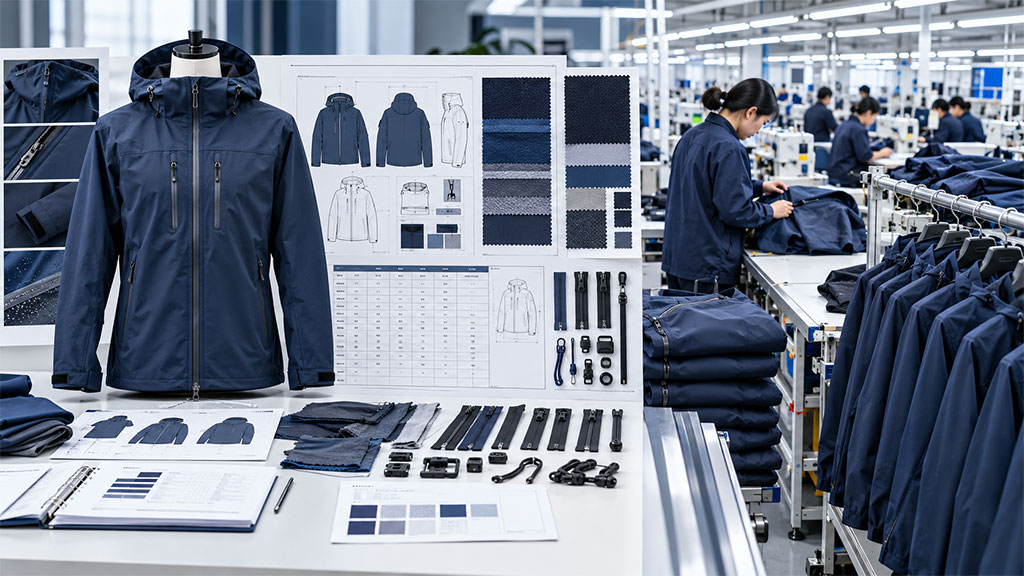
The approved Pre-Production Sample (PPS) normally becomes the physical reference for manufacturing. The factory and buyer should also confirm the associated technical specifications, including:
- Approved fabric and color
- Measurement chart and tolerances
- Construction details
- Trims and accessories
- Zippers and buttons
- Labels
- Logo artwork
- Printing or embroidery specifications
- Washing and finishing requirements
- Packaging instructions
Any unresolved specification should be clarified before bulk cutting.
This is especially important for waterproof jackets, ski jackets, softshells, workwear, and performance apparel, where material and construction requirements can be more complex.
Why PPS Approval Matters
A successful sample establishes the production target. Without a clearly approved PPS, different interpretations between the brand and manufacturer can lead to measurement deviations, material substitutions, construction changes, or branding errors during bulk production.
2. Prepare and Verify Bulk Materials
After PPS approval, the factory prepares all materials required for the production order. Depending on the garment, this can include:- Main fabric
- Lining and interlining
- Zippers
- Buttons
- Elastic and webbing
- Labels and hangtags
- Sewing thread
- Printing and embroidery materials
- Packaging materials
- Garment weight
- Hand feel
- Color
- Waterproof performance
- Breathability
- Abrasion resistance
- Production cost
3. Inspect Fabric Before Cutting
Fabric inspection is one of the first physical quality checkpoints in bulk apparel manufacturing.
Production rolls may be checked for:
- Holes and stains
- Weaving defects
- Color variation
- Printing defects
- Uneven texture
- Width variation
- Shrinkage
- GSM variation
Depending on the product, performance testing may also be required. Outdoor garments, for example, may require evaluation of tensile strength, tear resistance, abrasion resistance, water resistance, waterproof performance, or breathability.
The principle is straightforward:
Identify material problems before they become finished-garment problems.
Detecting defective fabric before cutting is generally less disruptive than discovering the same issue after panels have already been cut or garments assembled.
4. Control Fabric Relaxation, Spreading and Cutting
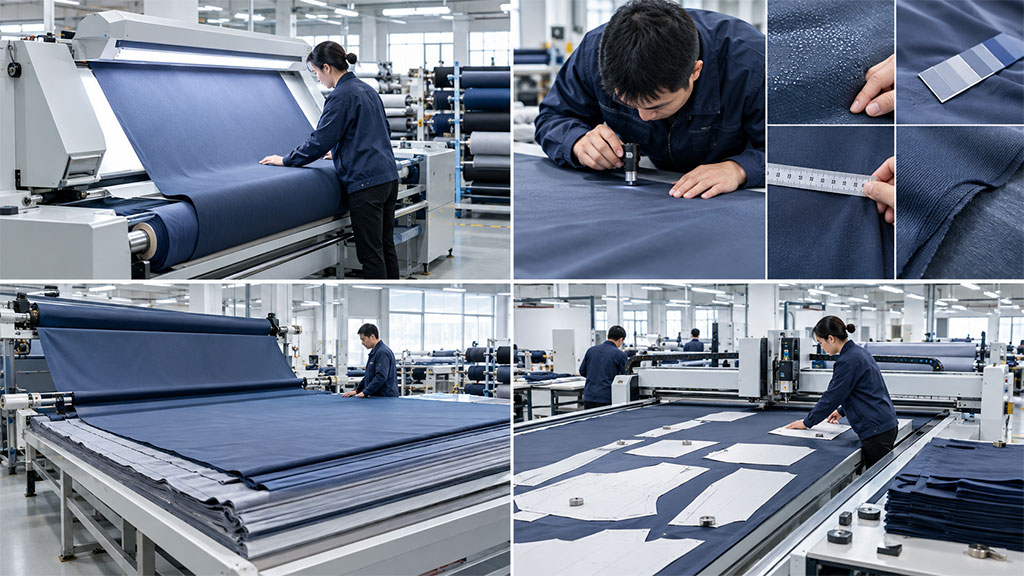
Once materials pass the required checks, production moves to fabric preparation and cutting. Some fabrics require relaxation before spreading to reduce dimensional variation caused by fabric tension. During spreading and cutting, the main controls include:Fabric Direction
Grain, nap, surface direction, or other directional characteristics must be correctly aligned.Layer Alignment
Fabric layers should remain accurately positioned during spreading to prevent panel variation.Marker Efficiency
The cutting marker determines how pattern pieces are arranged and directly influences fabric consumption.Cutting Accuracy
Panels must follow the approved pattern dimensions and specifications. For large B2B orders, even a small cutting error can be multiplied across thousands of garments. Accurate cutting therefore supports both material utilization and garment consistency.5. Standardize Sewing and Garment Assembly
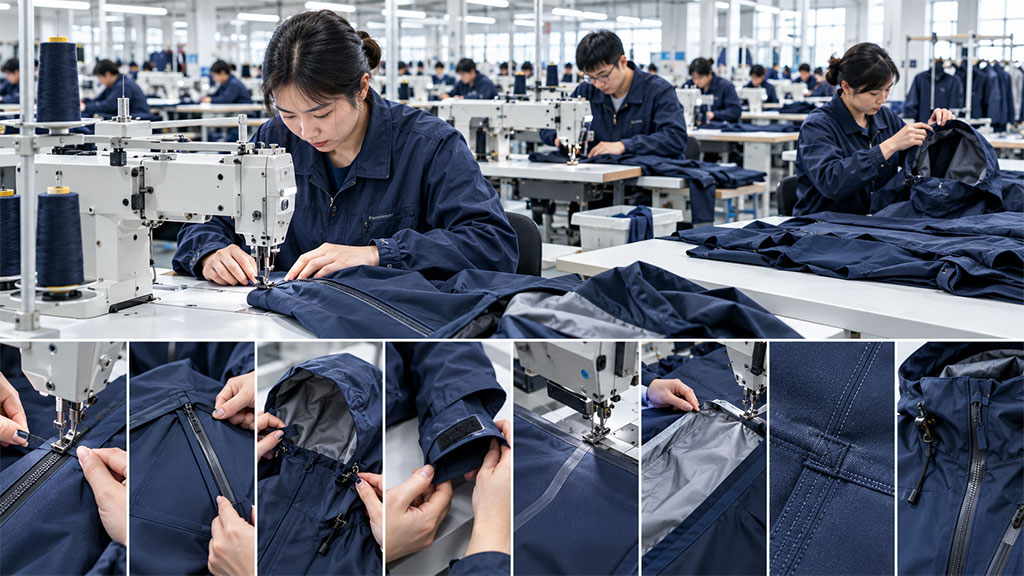
After cutting, garment panels are bundled and transferred to the sewing line. The sewing sequence depends on the garment structure. A basic T-shirt may involve relatively straightforward operations, while an outdoor shell jacket may require:- Multiple panel assembly
- Zipper installation
- Pocket construction
- Hood assembly
- Elastic adjustment
- Seam sealing
- Lining attachment
- Cuff construction
- Reinforcement operations
- Stitch density
- Seam allowance
- Stitch strength
- Seam alignment
- Thread tension
- Pocket positioning
- Zipper installation
- Panel matching
6. Apply Branding According to Approved Specifications
Branding operations may take place before or after garment assembly depending on the product and application method. Common B2B apparel branding methods include:- Screen printing
- Digital printing
- Heat transfer
- Embroidery
- Woven labels
- Silicone labels
- Patches
- Custom hangtags
- Logo size
- Position
- Color
- Application method
- Orientation
- Production tolerance
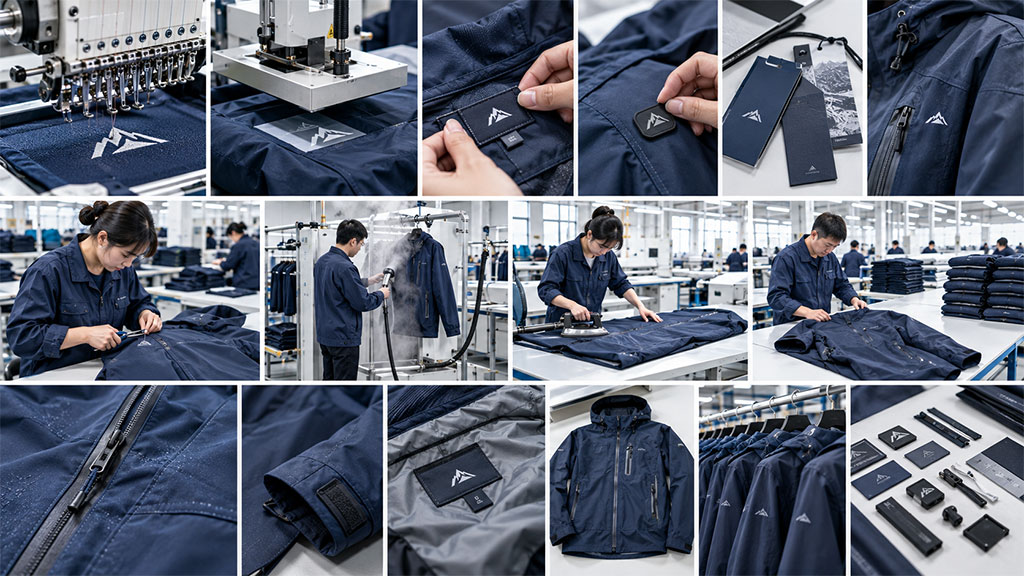
7. Complete Finishing Before Final Inspection
After assembly and branding, garments move through finishing operations. Depending on the product, finishing can include:- Thread trimming
- Loose-thread removal
- Pressing or steaming
- Washing
- Cleaning
- Final measurement
- Metal detection where required
- Garment inspection
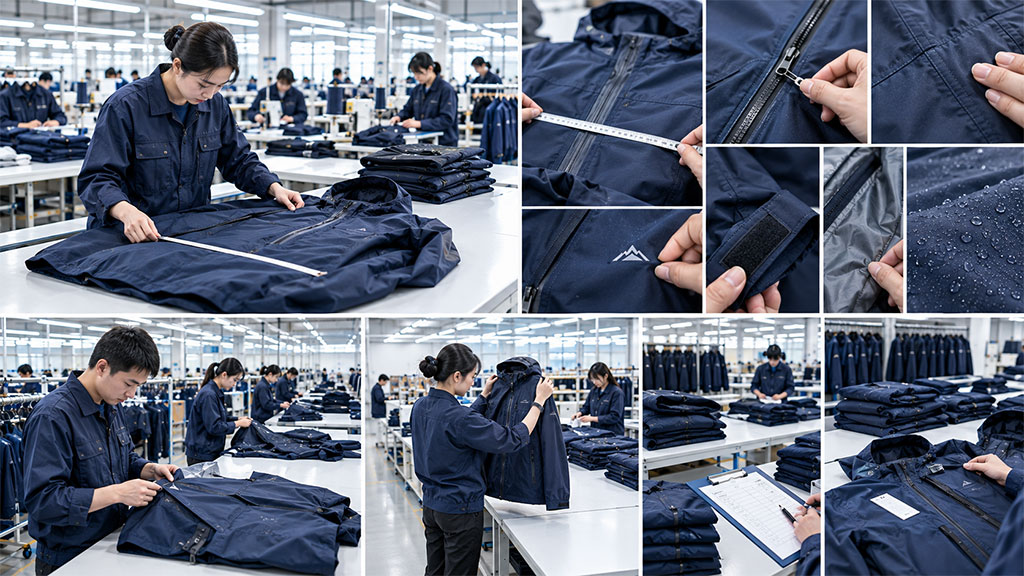
8. Use Inline QC to Detect Problems Early
One of the most important principles in bulk apparel manufacturing is to identify recurring defects while production is still running. Inline QC may focus on critical operations such as:- Sewing seams
- Zipper installation
- Pocket attachment
- Collar construction
- Hood assembly
- Logo placement
- Measurement points
- Seam sealing
- Functional components
9. Track Production Progress and Output
Bulk production control is not limited to garment quality. Production progress also needs to be monitored against the agreed schedule. Useful production indicators include:- Planned quantity
- Daily output
- Completed quantity
- Work-in-progress quantity
- Defect rate
- Rework quantity
- Material availability
- Production bottlenecks
- Estimated completion date
10. Complete Final Inspection and AQL Evaluation
After bulk production is completed, finished garments should be inspected before shipment.
A final inspection may cover:
- Appearance
- Workmanship
- Measurements
- Fabric condition
- Color consistency
- Logo placement
- Labels
- Zippers and accessories
- Functional details
- Packaging
For many B2B apparel orders, AQL inspection provides a structured sampling method for evaluating a production lot rather than checking every garment.
However, AQL should not replace process control.
A stronger quality system combines:
Approved PPS + Material Inspection + Inline QC + Final Inspection
This layered approach addresses problems at different stages of production rather than relying exclusively on final inspection.
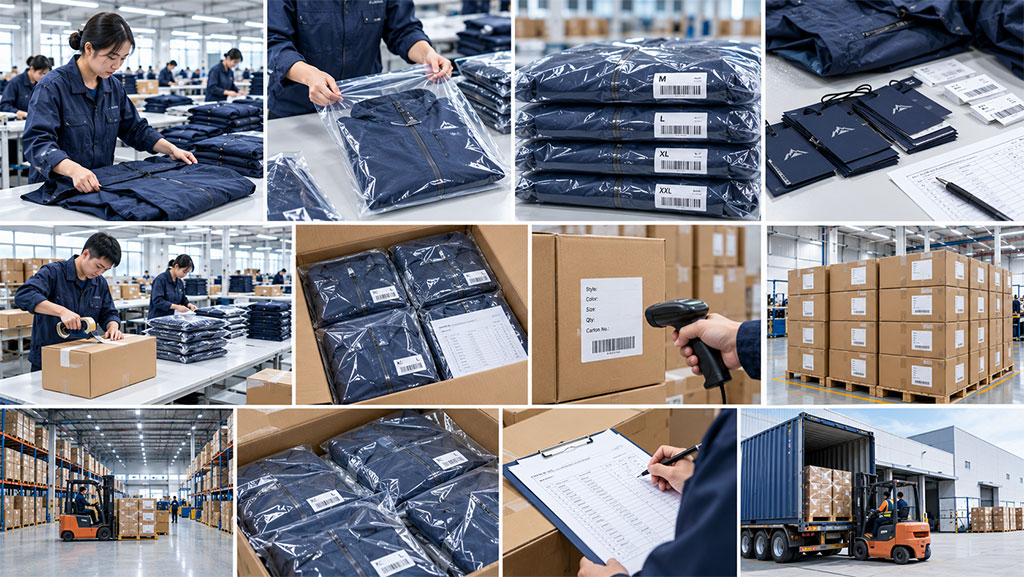
11. Verify Packing Before Shipment
Once the production lot passes the required inspection, garments enter final packing. Packing may include:- Folding
- Polybagging
- Size stickers
- Barcode labels
- Hangtags
- Size assortment
- Carton packing
- Carton marking
12. Match Shipment Documentation With the Physical Order
Before dispatch, the production team and buyer may confirm:
- Final quantity
- Inspection status
- Packing list
- Carton count
- Carton dimensions
- Shipping marks
- Commercial documents
- Shipping terms
- Delivery schedule
The exact logistics process depends on the agreed delivery terms, such as FOB, CIF, DDP, or another arrangement.
The final objective is simple: the physical shipment and its documentation should match the approved order.
Where Do Most Bulk Production Problems Occur?
Bulk apparel manufacturing is a chain:
Specifications → Materials → Cutting → Sewing → Finishing → QC → Packing → Shipment
A problem introduced early can become increasingly expensive later.
| Problem | Starting Stage | Possible Result |
|---|---|---|
| Incorrect fabric | Material preparation | Rework or production hold |
| Wrong pattern | Cutting | Incorrect measurements |
| Cutting variation | Cutting | Panel mismatch |
| Sewing defect | Assembly | Rework |
| Wrong logo position | Decoration | Rejection |
| Measurement deviation | Sewing/finishing | Size inconsistency |
| Repeated workmanship defect | Production | Large-scale rework |
| Packing mistake | Packing | Warehouse receiving issues |
| Late production | Production planning | Shipment delay |
This demonstrates why reliable bulk apparel manufacturing is fundamentally a process-control challenge, not simply a question of sewing capacity.
How Can B2B Brands Reduce Bulk Production Risk?
1. Provide Complete Technical Specifications
A production-ready tech pack reduces interpretation differences between the brand and manufacturer.2. Approve Materials Early
Confirm fabric, colors, trims, zippers, labels, and other accessories before bulk production begins.3. Separate Development, Fit and PPS Approvals
Different sample stages serve different purposes. Keeping these checkpoints separate reduces uncertainty before production.4. Freeze Major Specifications Before Cutting
Major changes after bulk production begins can increase material costs, rework, and schedule disruption.5. Establish Multiple QC Checkpoints
Combine material inspection, inline QC, and final inspection instead of relying only on the final inspection.6. Centralize Buyer Feedback
Consolidated comments help reduce contradictory instructions and unnecessary production revisions.7. Track Production Against the Agreed Schedule
Monitoring output and bottlenecks allows the factory and buyer to respond earlier when production begins to fall behind.How Long Does Apparel Bulk Production Take?
There is no universal production lead time for every apparel order.
The timeline depends on factors such as:
- Garment complexity
- Order quantity
- Fabric availability
- Trim availability
- Sampling status
- Decoration requirements
- Testing requirements
- Factory capacity
- Production season
- Buyer approval speed
For many apparel categories, bulk production can take several weeks after materials and PPS approvals are complete. Complex outerwear and technical apparel may require additional time.
A key distinction for B2B buyers is the difference between development lead time and bulk production lead time.
The total project may take longer because of fabric development, sampling, approvals, testing, and material preparation even when the actual sewing period is relatively short.
Sample Production vs. Bulk Production: What Changes?
| Factor | Sample Production | Bulk Production |
|---|---|---|
| Objective | Validate product | Manufacture at scale |
| Quantity | Small | Large |
| Main Focus | Design, fit, construction | Consistency, efficiency, output |
| Materials | Sample materials | Approved bulk materials |
| QC | Sample evaluation | Inline + final QC |
| Reference | Tech pack + comments | Approved PPS |
| Main Risk | Incorrect design/fit | Repeated production defects |
| Cost Priority | Development efficiency | Cost-per-unit optimization |
B2B Apparel Bulk Production Checklist
Before authorizing bulk production, buyers should confirm:
Product
- Approved PPS
- Final measurement chart
- Measurement tolerances
- Construction specifications
Materials
- Approved fabric
- Fabric color
- Fabric composition
- Trims
- Zippers and accessories
Branding
- Logo artwork
- Logo placement
- Printing/embroidery specifications
- Labels
- Hangtags
Quality
- Inspection standard
- Defect classification
- AQL requirements
- Testing requirements
- Measurement standards
Production
- Final quantity
- Size breakdown
- Production schedule
- Material readiness
- QC checkpoints
Packing - Folding method
- Polybag requirements
- Barcode
- Carton quantity
- Carton markings
Shipment
- Packing list
- Carton count
- Shipping terms
- Target ship date
- Required documents
This checklist helps prevent specification gaps from becoming production problems.
FAQ: Apparel Bulk Production Workflow
1. What is the apparel bulk production workflow?
The typical workflow includes PPS approval, bulk material preparation, fabric inspection, spreading and cutting, sewing, branding, finishing, inline QC, final inspection, packing, and shipment.2. What happens after PPS approval?
The factory prepares approved bulk materials, organizes production planning, begins cutting and sewing, and applies the agreed quality-control procedures.3. What is the most important quality checkpoint in bulk production?
No single checkpoint replaces all others. Material inspection, inline QC, and final inspection identify different types of problems, so a complete QC system is more effective than relying on one inspection.4. Why is inline QC important in apparel manufacturing?
Inline QC identifies recurring defects while production is still running, allowing the factory to correct the process before the defect affects a large quantity.5. Is AQL inspection enough for bulk apparel production?
No. AQL is a sampling-based final inspection method. It works best alongside approved samples, material inspection, and inline quality control.6. What causes apparel bulk production delays?
Common causes include late fabric confirmation, unavailable trims, repeated production changes, unclear specifications, quality problems, rework, and insufficient production capacity.7. Can brands make changes after bulk production starts?
Changes are possible, but they can affect material usage, cost, production efficiency, and delivery timing. Major changes should be evaluated before implementation.8. How can apparel brands reduce bulk production risks?
Brands can reduce risk by providing complete specifications, approving materials and samples early, defining QC requirements, freezing major specifications before cutting, and maintaining clear communication with the manufacturer.Conclusion: Build a Controlled Apparel Bulk Production Process
Reliable apparel bulk production is not simply about moving garments through a sewing line. It is a controlled sequence in which each stage protects the next:
Approved Specifications → Verified Materials → Accurate Cutting → Consistent Sewing → Controlled Finishing → Inline QC → Final Inspection → Accurate Packing → Shipment
For B2B clothing brands, the ultimate goal is to reproduce the approved sample at scale while controlling quality, cost, production efficiency, and delivery risk.
An experienced OEM/ODM manufacturing partner can coordinate these stages from product development and fabric sourcing through sampling, bulk production, QC, packing, and shipment.
Written by the Simmerui Apparel Manufacturing Team.
We specialize in OEM and ODM apparel production for global B2B brands, with integrated capabilities across product development, fabric sourcing, sampling, quality control, and scalable manufacturing. Our experience covers outdoor apparel, performance wear, casual clothing, and private label collections, helping brands reduce production risks, optimize costs, and build reliable long-term manufacturing partnerships.