
Fabric selection is a strategic decision in custom apparel manufacturing because it impacts fit consistency, performance, and production efficiency. This guide explains how B2B buyers evaluate stretch and recovery, fabric weight and structure, shrinkage stability, breathability, durability, and functional finishes—then connect those requirements to costing, MOQ, and factory compatibility.
You’ll also get a practical step-by-step fabric evaluation process and common mistakes to avoid, helping reduce sample revisions, bulk defects, and delays before PPS approval.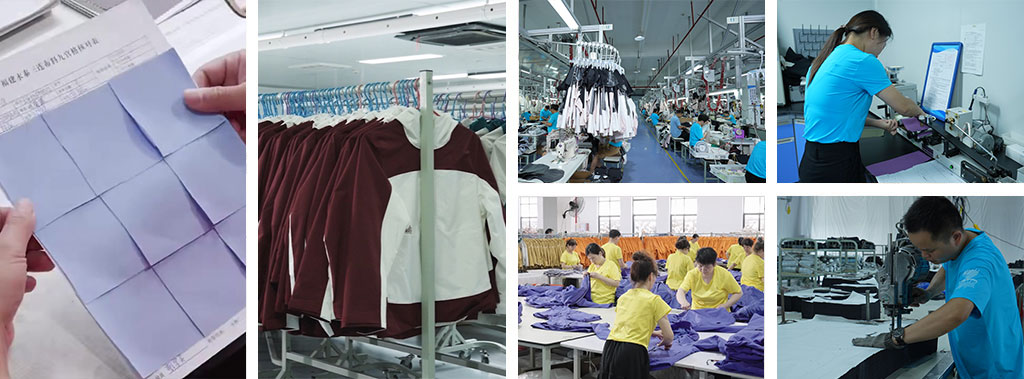
Why Fabric Selection Matters in Apparel Manufacturing
In custom apparel manufacturing, fabric influences far more than appearance. It affects:- Garment fit and silhouette
- Comfort and wearability
- Durability and wash performance
- Production complexity
- Sampling efficiency
- Manufacturing cost
- Customer satisfaction
Requirement | What to Test | Typical Risk | What to Ask Supplier / Factory |
Fit stability | Shrinkage / relaxation after wash | Size drift after pro-duction | Test report + size tole-rance standard |
Stretch recovery | Recovery % after repe-ated stretch | Bagging / sagging at knees & elbows | Recovery spec + test cycles |
Dye consistency | Shade variation betwee-n rolls/lots | Bulk color mismatch | Lab dips + lot control process |
Sewing compatibility | Trial sewing on product-ion machines | Needle cutting / se-am puckering | Factory sewing capability proof |
Performance finish | Hydrostatic / MVTR / D-WR performance | Delamination or fini-sh failure | Finish spec + third-party testing |
Abrasion resistance | Martindale or wear resi-stance test | Surface wear / pilli-ng | Abrasion test standard + report |
Pilling resistance | Pilling grade after rubb-ing | Fuzzy surface appe-arance | Pilling test results |
Color fastness | Wash / rub / light fast-ness | Color bleeding or f-ading | Fastness report + testing method |
Seam strength | Tensile strength at sea-m points | Seam bursting duri-ng wear | Seam strength standard |
Waterproof construc-tion | Seam sealing inspecti-on | Leakage at taped s-eams | Seam tape specification + QC method |
Breathability | MVTR or airflow test | Poor comfort during activity | Breathability performance data |
Fabric handfeel consistency | Handle comparison be-tween batches | Inconsistent custo-mer experience | Bulk fabric approval standard |
Print durability | Wash & stretch print t-est | Cracking / peeling l-ogos | Print test report + ink specification |
Trim durability | Zipper/button/snap te-sting | Trim breakage or ru-sting | Trim supplier certification |
Dimensional stability | Wash & dry measurem-ent check | Twisting or deform-ation | Dimensional stability report |
Fabric skewing | Spirality/torque testing | Side seam twisting | Skew tolerance standard |
UV protection | UPF testing | Insufficient sun pro-tection | Certified UPF report |
Thermal performance | Insulation retention te-st | Heat loss in cold co-nditions | Thermal rating data |
Anti-odor / antimicrobial finish | Functional finish effec-tiveness | Finish degradation after washing | Finish durability test cycles |
Bulk production consistency | PP sample vs bulk com-parison | Inconsistent final quality | PP approval process + inline QC plan |
1. Improve Fit Consistency by Choosing the Right Fabric Behavior
Fit consistency is one of the biggest challenges in apparel production, and fabric behavior plays a major role in determining how garments fit during wear and after washing.Fabric Stretch and Recovery
Stretch fabrics improve comfort and mobility, especially for:- Activewear
- Leggings
- Uniforms
- Fitted garments
- Stretch percentage
- Recovery performance
- Shape retention
- Dimensional stability
Fabric Weight and Structure
Fabric weight changes how garments drape and hold shape. For example:- Lightweight fabrics create softer silhouettes
- Heavyweight fabrics provide structure and durability
- Medium-weight fabrics balance comfort and shape retention
Shrinkage and Fit Stability
Shrinkage is one of the most common causes of post-production sizing complaints. Even a 2–3% shrinkage inconsistency can create major fit problems during bulk production. Before approving production, experienced manufacturers usually conduct:- Wash testing
- Shrinkage testing
- Fabric relaxation
- Pre-shrinking treatment
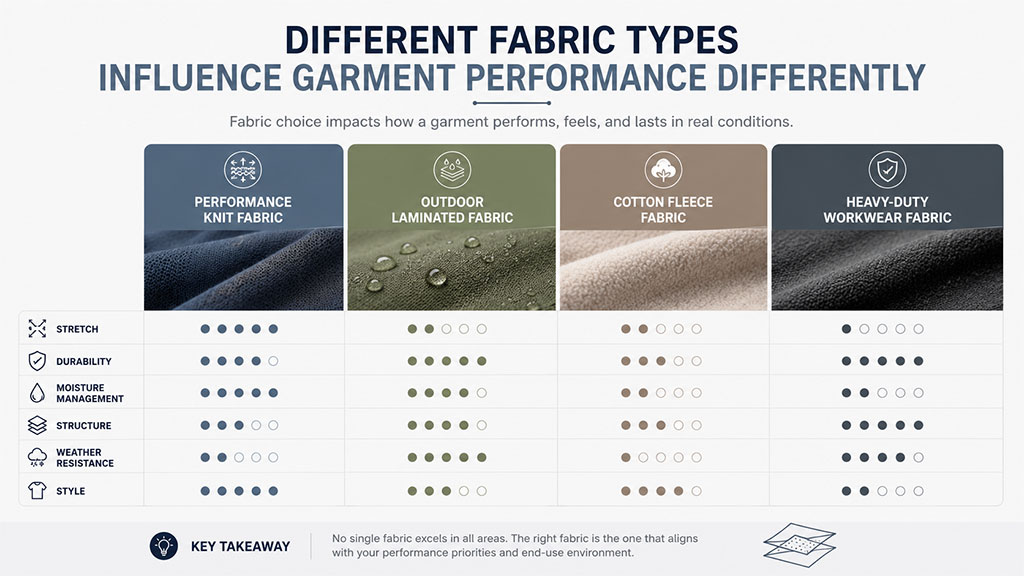
2. Match Fabric Performance to End Use to Reduce Failures
Different apparel categories require different performance characteristics. A visually attractive fabric may still fail if it cannot meet the garment’s functional requirements.Breathability and Moisture Management
For sportswear and activewear, breathable fabrics improve comfort during movement. Moisture-management fabrics help:- Reduce sweat buildup
- Improve drying speed
- Enhance wearer comfort
- Support athletic performance
Durability and Abrasion Resistance
For workwear, uniforms, and outdoor garments, durability is critical. Manufacturers often evaluate:- Abrasion resistance
- Tear strength
- Pilling resistance
- Seam stability
- Colorfastness
Weather Protection and Functional Finishes
Outdoor and technical apparel frequently rely on specialized fabric treatments such as:- Water resistance
- DWR coating
- Windproof lamination
- Thermal insulation
- UV protection
3. Control Unit Cost by Avoiding Hard-to-Produce Fabrics
Fabric cost is not only about material pricing. The wrong fabric can increase labor cost, production instability, and manufacturing waste.Raw Material Cost
Fiber composition strongly affects sourcing cost. For example:- Organic cotton is usually more expensive than standard cotton
- Nylon often costs more than polyester
- Functional fabrics increase sourcing complexity
- Sustainable fabrics may require certified supply chains
Cutting and Sewing Efficiency
Some fabrics are significantly more difficult to manufacture. Challenging materials may cause:- Fabric shifting during cutting
- Sewing instability
- Needle damage
- Increased labor time
- Higher defect rates
- Ultra-stretch fabrics
- Lightweight technical fabrics
- Slippery woven fabrics
- Laminated performance materials
Waste and Quality Risk
Low-quality or unstable fabrics often create:- Shade variation
- Fabric distortion
- Excess shrinkage
- Surface defects
- Higher rejection rates
Avoid Fabric Mistakes That Cause Revisions and Delays
One common mistake in custom apparel production is selecting fabric before confirming actual performance requirements. For example, some brands choose lightweight stretch fabrics for outdoor jackets to improve comfort, but later discover the fabric lacks enough structure for seam stability and waterproof lamination. This often leads to:- Repeated sample revisions
- Increased development cost
- Delayed production schedules
- Inconsistent bulk quality
Follow a 5-Step Fabric Evaluation Process Before Sampling
Professional apparel development usually follows a structured fabric evaluation process.Step 1 — Define the End Use
Determine whether the garment is intended for:- Fashionwear
- Activewear
- Workwear
- Outdoor apparel
- Uniform programs
Step 2 — Confirm Price Positioning
Fabric quality should align with:- Target retail pricing
- Brand positioning
- Customer expectations
Step 3 — Evaluate Performance Requirements
Check whether the fabric supports:- Stretch and recovery
- Breathability
- Waterproofing
- Abrasion resistance
- Thermal performance
Step 4 — Verify Production Compatibility
Before bulk production, buyers should confirm:- Factory production capability
- Fabric availability
- MOQ requirements
- Dye consistency
- Lead-time stability
Step 5 — Conduct Testing Before PPS Approval
Recommended evaluations include:- Wash testing
- Wear testing
- Shrinkage testing
- Colorfastness testing
- Performance testing

Why Early Fabric Confirmation Improves Production Efficiency
Many apparel production delays happen because fabric decisions are finalized too late. Early fabric confirmation allows:- More accurate pattern development
- Faster fit adjustments
- Better costing accuracy
- More reliable sourcing timelines
- Improved production planning
Final Thoughts
In professional apparel development, fabric selection is rarely just a sourcing decision — it is a product strategy decision. The right fabric improves not only garment performance, but also production stability, customer satisfaction, and long-term brand positioning. For B2B apparel buyers, evaluating fabric early and working closely with experienced manufacturing partners can significantly reduce development risk and improve manufacturing efficiency across the supply chain.FAQ
1.How does fabric selection affect garment fit?
Fabric affects fit through stretch, drape, weight, and shrinkage behavior. Different materials respond differently during wear and washing, which directly influences sizing consistency.2.Why does fabric choice impact production cost?
Fabric affects raw material pricing, sewing difficulty, production efficiency, quality control requirements, and defect risk.3.What fabric issues commonly delay bulk production?
Common issues include shrinkage instability, shade variation, poor recovery, sewing difficulty, and inconsistent dye lots.4.Should fabric be finalized before sampling?
Yes. Finalizing fabric before sampling improves fit accuracy, development efficiency, and production planning.5.What is the best fabric for custom apparel?
The best fabric depends on garment type, target market, performance requirements, and intended retail positioning.6.When should fabric be selected during product development?
Fabric should ideally be selected before final sampling. Early fabric selection improves fit accuracy, sourcing efficiency, and production planning.7. What documents should suppliers provide for fabric approval (lab dips, test reports, lot records)?
Suppliers should normally provide approved lab dips, fabric test reports, bulk lot/shade records, fabric specifications, shrinkage results, and performance testing data (such as color fastness, waterproofness, or stretch recovery if required). For bulk production, lot traceability records are also important for quality consistency.8.How to choose fabric for low MOQ programs without unstable dye lots?
For low MOQ orders, it’s safer to select stock-supported fabrics, core color programs, or mill carry-over qualities with stable replenishment. Avoid highly customized colors or small-batch reactive shades that may create dye lot variation. Request shade continuity policies from the supplier before approval.9.What’s the best testing set before PPS for different categories (activewear/outdoor/workwear)?
- Activewear: stretch recovery, color fastness, pilling, moisture management, shrinkage
- Outdoor: waterproofness, DWR durability, seam performance, breathability, abrasion resistance
- Workwear: tear strength, seam strength, abrasion resistance, color fastness, dimensional stability, functional safety compliance if required
Written by the Simmerui Apparel Development Team — supporting fashion brands, wholesalers, startups, and outdoor apparel companies with fabric sourcing, OEM development, sampling coordination, and scalable manufacturing solutions. Our workflow typically includes swatch review, lab dips, shrinkage and colorfastness testing, and sewing trials before PPS.