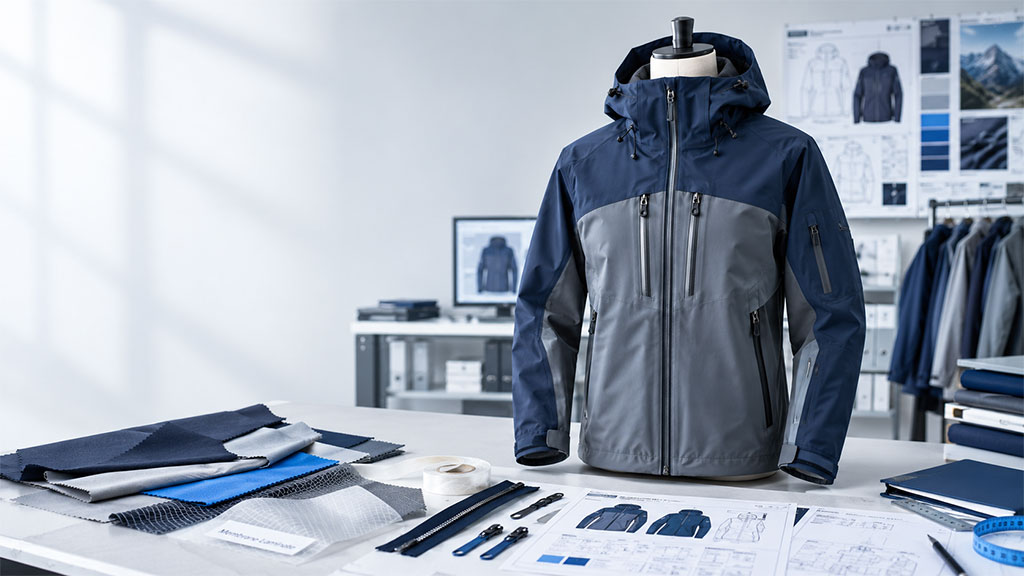
Developing a technical shell jacket requires more than selecting waterproof fabric. Outdoor apparel brands must balance breathability, fit, durability, garment weight, and production feasibility. This illustrative OEM case study explains how structured fabric evaluation, pattern adjustments, sample revisions, performance testing, and quality control can help resolve common development challenges. For B2B brands, working closely with an experienced manufacturing partner helps translate product requirements into production-ready specifications and reduce avoidable risks before bulk manufacturing.
1. Project Overview: Developing a Technical Shell Jacket
Technical shell jackets present several challenges for outdoor apparel brands. The finished garment must provide the required weather protection while maintaining mobility, comfort, durability, and a consistent appearance.
The development scenario in this article is illustrative and based on common technical apparel manufacturing challenges, rather than independently verified results from a specific client project.
The project requirements include:
- Weather protection: Select a shell fabric system that meets defined waterproof and wind-resistance targets.
- Breathability: Establish appropriate moisture vapor transmission requirements.
- Functional fit: Support movement and accommodate the intended layering system.
- Durable construction: Specify suitable seams, closures, reinforcement, and finishing.
- Production readiness: Convert approved design and performance requirements into repeatable manufacturing specifications.
The central challenge is balancing technical performance, wearer comfort, target cost, and bulk production feasibility.
2. Challenge One: Selecting the Right Shell Fabric
The Problem: Balancing Protection, Breathability, Weight, and Cost
A fabric that performs well in one area may introduce limitations elsewhere. Heavier materials can improve durability but increase garment weight, while highly protective constructions require careful consideration of breathability, lamination, and seam sealing.
Fiber composition alone cannot determine whether a shell jacket will meet its performance targets.
The Solution: Evaluate the Complete Fabric System
Before approving materials, the development team should translate the product brief into measurable requirements.
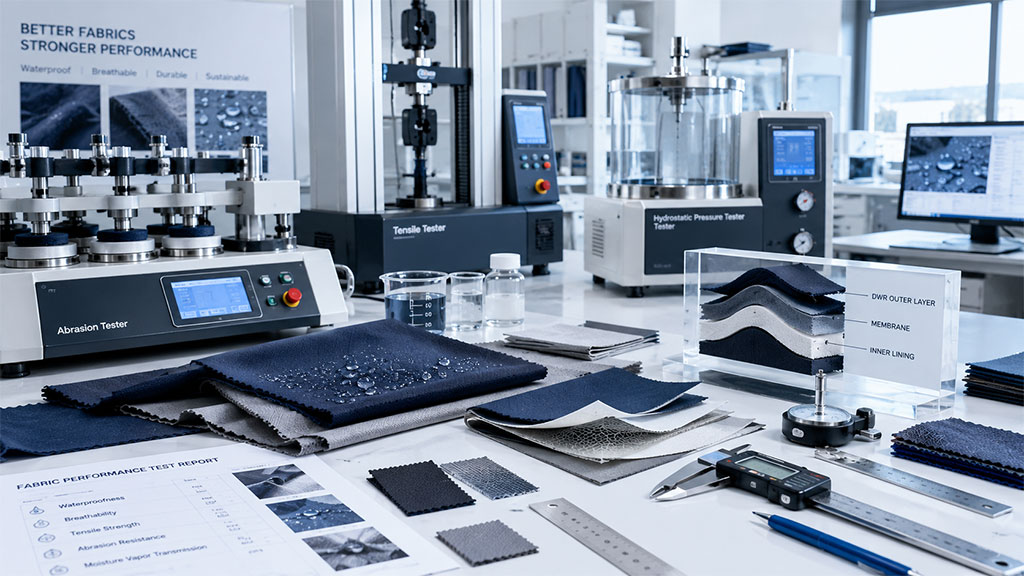
Key evaluation factors include:
| Evaluation factor | What to verify |
|---|---|
| Fabric composition | Nylon, polyester, or an appropriate blend |
| Fabric weight | Balance between weight, durability, and intended use |
| Waterproofness | Required hydrostatic pressure rating and test method |
| Breathability | Moisture vapor transmission rate (MVTR) or another agreed measure |
| Durability | Abrasion resistance and tear strength |
| Surface treatment | Water-repellent finish and durability requirements |
| Construction | Membrane, coating, lamination, and seam-sealing compatibility |
| Commercial feasibility | Material availability, MOQ, lead time, and target cost |
For waterproof breathable jackets, fabric, membrane or coating, lamination, seam construction, and finished-garment performance must be evaluated together.
Nylon may be suitable when abrasion resistance and a supple hand feel are priorities. Polyester may be appropriate when UV resistance, dimensional stability, or cost efficiency matters. Neither fiber guarantees waterproofness or superior breathability by itself.
Development takeaway: Approve materials against documented performance criteria rather than a fabric name or marketing claim.
3. Challenge Two: Correcting Fit and Mobility Issues
The Problem: Technical Features Complicate Garment Fit
A technical shell jacket must support movement without excessive bulk or compromised protection.
Common problems include restricted shoulder movement, sleeve twisting, excessive torso volume, poor hood positioning, and insufficient room for layering. Pockets and closures can also interfere with movement or garment balance.
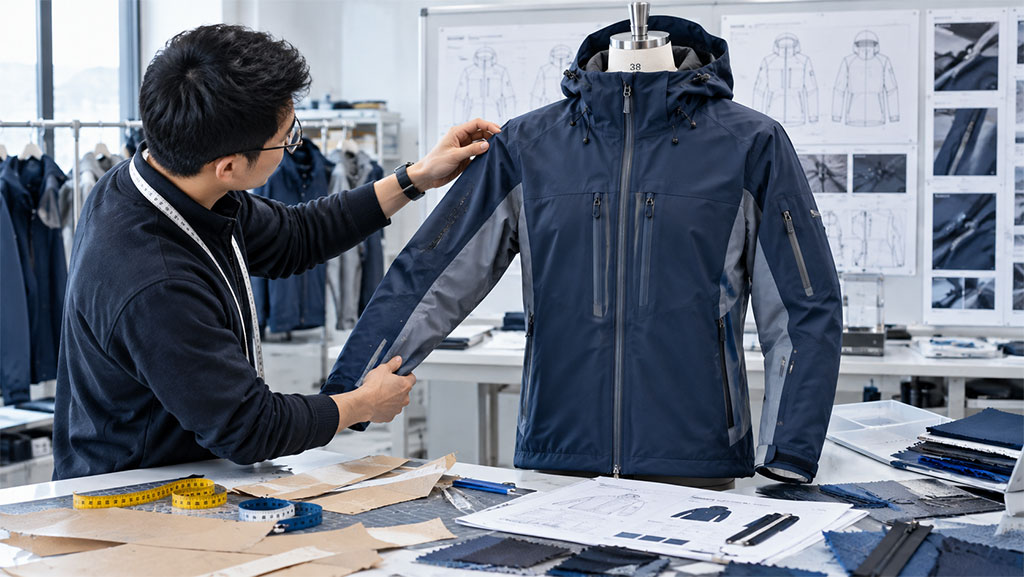
These issues may not be obvious from a technical drawing. Physical sampling is essential to evaluate the garment in use.
The Solution: Follow a Structured Sample Review Process
Step 1: Review the tech pack.
Confirm measurements, construction details, size grading, layering requirements, and functional features before pattern development.
Step 2: Develop the prototype.
Create a physical sample using the agreed design direction, materials, and major construction details.
Step 3: Evaluate fit and mobility.
Assess shoulder movement, sleeve articulation, torso volume, hood coverage, and access to pockets and closures.
Step 4: Document specific corrections.
Convert subjective feedback into actionable instructions, such as adjusting sleeve pitch, revising underarm geometry, changing body ease, or repositioning a pocket.
Step 5: Review the revised sample.
Confirm that the changes resolve the identified issues without creating new problems in appearance, comfort, or functionality.
Fit approval should reflect the intended application. A shell jacket designed for technical hiking may require different movement and layering allowances from a lightweight urban rain jacket.
4. Challenge Three: Validating Finished-Garment Performance
The Problem: Fabric Test Results Do Not Guarantee Garment Performance
A fabric may meet laboratory requirements while the finished jacket still falls short of expectations.
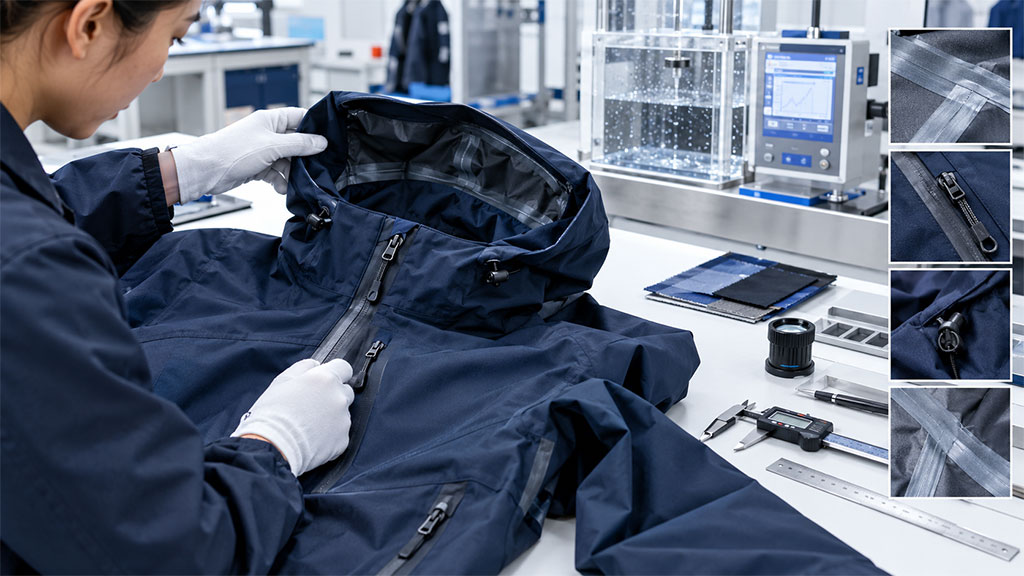
Potential weak points include inconsistent seam sealing, zipper integration, hood adjustment systems, and junctions where multiple components meet. Water may enter through construction defects even when the main fabric provides adequate waterproof performance.
A durable water-repellent (DWR) finish helps water bead on the fabric surface, but it does not independently make a garment waterproof.
The Solution: Combine Material Testing With Garment-Level QC
The OEM development team should identify which requirements need material-level testing and which require finished-product evaluation.
| Quality area | Recommended evaluation |
|---|---|
| Waterproof fabric performance | Hydrostatic pressure testing |
| Breathability | MVTR or another specified moisture vapor test |
| Fabric durability | Abrasion and tear-strength testing |
| Color performance | Applicable colorfastness tests |
| Seam integrity | Seam construction and seam-sealing inspection |
| Zippers and closures | Functional operation and component inspection |
| Garment measurements | Verification against approved specifications |
| Finished-product performance | Applicable garment-level testing |
Testing methods and acceptance criteria should be agreed upon according to the product brief, intended market, applicable standards, and buyer requirements.
For example, a waterproof hiking shell may require specific hydrostatic pressure performance and seam-sealing verification. A lightweight wind-resistant jacket may require a different testing scope.
Development takeaway: Verify the complete garment against its intended performance requirements instead of relying exclusively on fabric supplier documentation.
5. Challenge Four: Preparing for Consistent Bulk Production
The Problem: Sample Approval Does Not Guarantee Production Consistency
A successful prototype does not automatically ensure consistent bulk manufacturing. Unclear specifications or uncontrolled changes can create variations in measurements, materials, seam sealing, and finished-product quality.
These gaps may lead to rework, delivery delays, and disputes over product acceptance.
The Solution: Establish Pre-Production Controls
Before bulk production begins, the brand and OEM manufacturer should confirm:
- Approved materials: Document accepted fabrics, trims, colors, and relevant performance requirements.
- Final measurement chart: Define measurement points, tolerances, and grading rules.
- Construction specifications: Confirm seam types, stitching, seam-sealing methods, and critical operations.
- Approved sample: Maintain a documented reference sample and record authorized deviations.
- Inspection criteria: Define visual, measurement, functional, and performance checks.
- Change control: Require review and approval before material substitutions or specification changes.
For technical shell jackets, critical checkpoints may include seam-sealing consistency, zipper installation, hood construction, pocket placement, and measurements affecting mobility and layering.
A risk-based inspection plan helps prioritize the garment features most likely to affect performance and customer satisfaction.
Development takeaway: Production readiness depends on clear specifications, controlled changes, and repeatable quality checks—not sample approval alone.
6. Technical Shell Jacket OEM Development Workflow
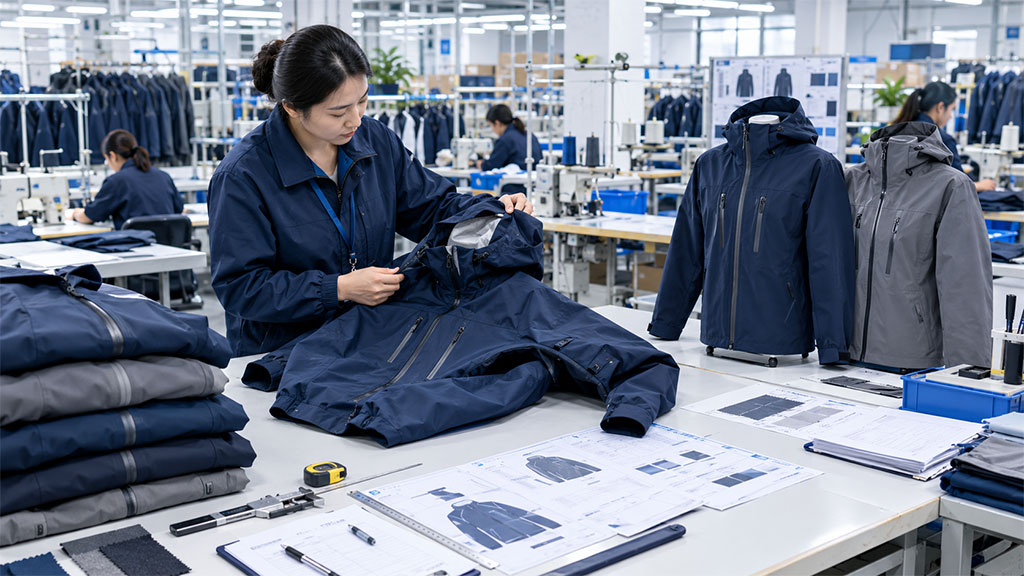
A structured workflow connects product requirements with manufacturing execution.
Project Brief → Fabric Evaluation → Pattern Development → Prototype Sampling → Fit Review → Sample Revision → Performance Validation → Pre-Production Approval → Bulk Manufacturing → Final Inspection
Each stage should have a defined output and approval requirement.
- Project brief: Confirm intended use, performance priorities, target cost, and order requirements.
- Fabric evaluation: Compare material options, test information, availability, and commercial feasibility.
- Pattern development: Establish garment measurements and construction details.
- Prototype sampling: Review the initial design and workmanship.
- Fit review and revision: Document feedback and verify corrections.
- Performance validation: Check compliance with agreed test criteria.
- Pre-production approval: Confirm the approved sample and production specifications.
- Bulk manufacturing: Maintain process consistency and monitor critical operations.
- Final inspection: Verify finished goods against buyer-approved acceptance criteria.
Sampling rounds and testing scope vary with design complexity, material technology, and identified risks. A straightforward shell jacket may require fewer revisions than a waterproof garment with complex pattern engineering and extensive seam sealing.
7. How Simmerui Supports Technical Shell Jacket OEM Manufacturing
Simmerui supports global B2B apparel brands through OEM/ODM product development, fabric sourcing, sample development, quality control, and scalable manufacturing coordination.
For technical shell jacket projects, collaboration may include:
- Reviewing the product brief and performance targets.
- Comparing suitable fabric and trim options.
- Coordinating pattern development and prototype sampling.
- Organizing fit feedback and sample revisions.
- Reviewing material and finished-garment testing requirements.
- Documenting approved specifications and quality checkpoints.
- Coordinating bulk production against agreed requirements.
Early collaboration helps identify specification gaps and potential manufacturing risks before they affect production schedules or finished-garment quality.
The objective is to align design intent, technical performance, and manufacturing execution through a clearly documented development process.
Frequently Asked Questions
1. What does a technical shell jacket OEM manufacturer do?
A technical shell jacket OEM manufacturer produces jackets according to a brand’s design, technical specifications, material requirements, and quality standards. Services may include fabric sourcing, pattern development, sampling, testing coordination, and bulk manufacturing.2. What fabric is best for a waterproof shell jacket?
The best option depends on waterproofness, breathability, weight, durability, budget, and intended use. Nylon and polyester can both be used in waterproof shell systems. The complete construction, including the membrane or coating and seam sealing, must meet the specified requirements.3. How many sampling rounds does a technical shell jacket require?
There is no universal number. Development may involve an initial prototype, fit revisions, material or construction adjustments, and a pre-production sample. More complex waterproof garments may require additional rounds.4. How is waterproof performance evaluated?
Evaluation may include hydrostatic pressure testing, seam-sealing inspection, and suitable garment-level testing. Methods and acceptance criteria should be agreed upon before production.5. How can brands reduce shell jacket development costs?
Define requirements early, select commercially feasible materials, consolidate sample feedback, document revisions, and validate critical construction details before bulk production. Skipping essential fit or performance checks may increase downstream costs.6. What information is needed for an OEM shell jacket quotation?
Provide design references or a tech pack, fabric requirements, target performance levels, size range, estimated order quantity, color and trim details, target delivery date, and relevant compliance expectations. Identify any specifications that remain open for development.7. What is the difference between a prototype and a pre-production sample?
A prototype evaluates design direction, fit, and construction. A pre-production sample more closely represents the approved product and manufacturing specifications before bulk production.8. How can brands improve bulk production consistency?
Use an approved reference sample, documented material and construction specifications, defined measurement tolerances, clear inspection criteria, and formal change control. These controls help manufacturing teams reproduce the approved product more consistently.Conclusion: Turn Technical Requirements Into Production-Ready Shell Jackets
Successful technical shell jacket OEM development requires coordinated fabric selection, pattern engineering, fit evaluation, performance testing, and manufacturing quality control.
For B2B apparel brands, the priorities are to define measurable requirements early, evaluate the complete garment through structured sample reviews, and document approved specifications before bulk production.
Planning a technical shell jacket collection? Contact Simmerui to discuss your product requirements, material options, sampling needs, and OEM/ODM manufacturing plan.
Written by the Simmerui Apparel Development Team
The Simmerui Apparel Development Team supports global B2B brands with product development, fabric sourcing, sampling, quality control, and manufacturing coordination across outdoor apparel, performance wear, and private-label collections. Our focus is helping brands align product requirements with practical manufacturing processes and build reliable long-term partnerships.