
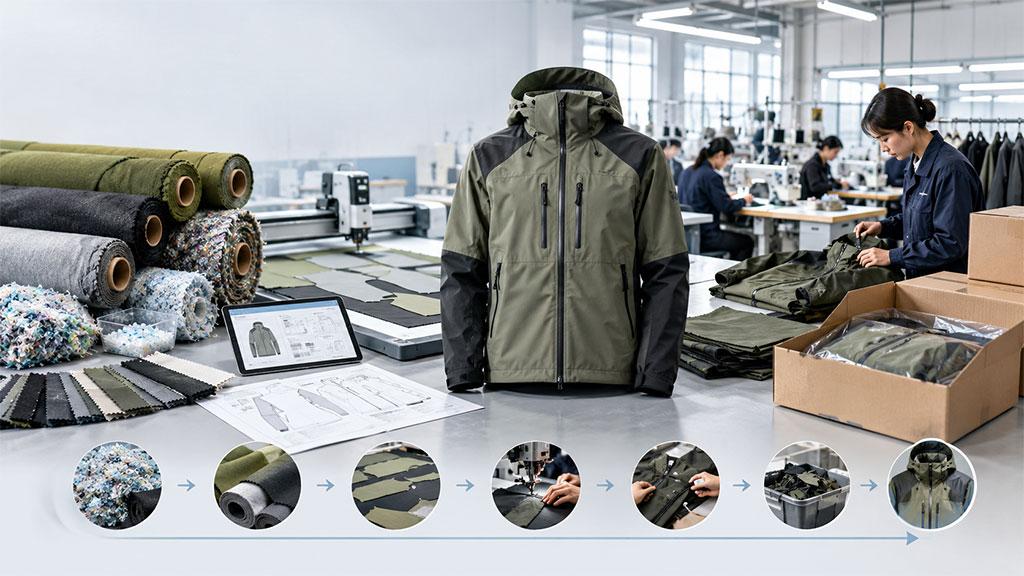
Eco-friendly apparel manufacturing is not simply about choosing recycled or organic fabrics. For B2B apparel brands, it involves material sourcing, production efficiency, waste reduction, chemical management, product durability, packaging, quality control, and supply-chain documentation. This guide explains what buyers should evaluate when developing sustainable OEM apparel and how to turn environmental objectives into measurable manufacturing requirements.
Introduction
For apparel brands, sustainability is increasingly becoming a product-development and sourcing consideration rather than a marketing statement.
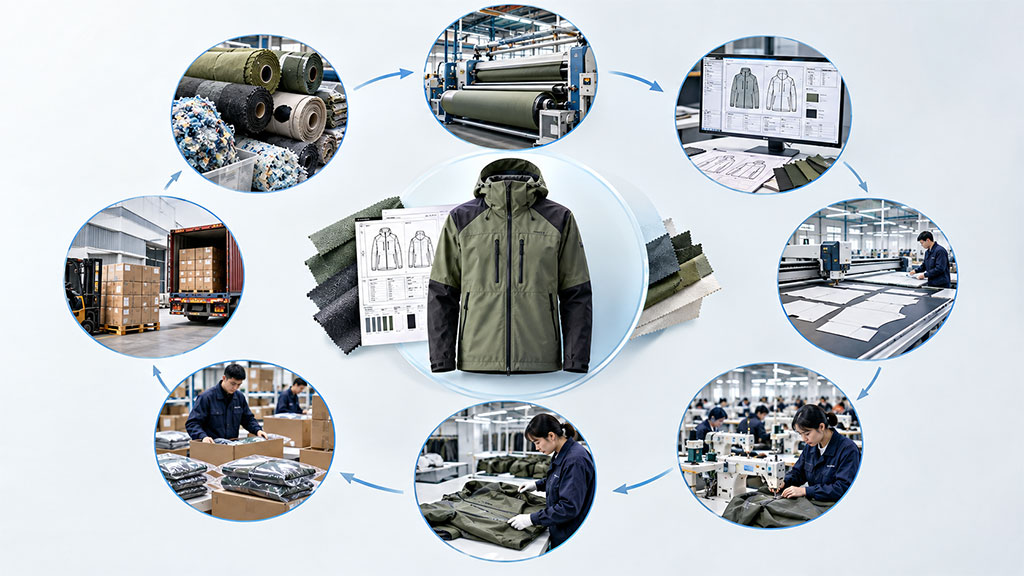
In practice, eco-friendly apparel manufacturing means reducing environmental impact across the garment production process—from material selection and fabric processing to cutting, sewing, quality control, packaging, and shipment.
The key point is that one sustainable feature does not automatically make an entire garment sustainable.
A jacket made with recycled polyester may still involve inefficient cutting, excessive sampling, poor durability, or unnecessary packaging. Likewise, a conventional material may deliver longer product life and lower production waste through efficient manufacturing and durable construction.
For B2B buyers, the better approach is therefore to evaluate the complete manufacturing system.
What B2B Buyers Should Evaluate
1. Responsible Fabric Sourcing
Fabric is one of the most important sustainability decisions in apparel development.
Depending on the product and target market, brands may consider:
- Recycled polyester
- Recycled nylon
- Organic cotton
- Recycled cotton
- Linen
- Hemp
- Lyocell
- Other responsibly sourced fibers
However, material selection must also satisfy product requirements.
For outdoor and performance apparel, buyers may need to balance water resistance, breathability, abrasion resistance, wind protection, durability, lightweight construction, cost, and end-market requirements.
Environmental considerations + Product performance + Durability + Cost should be evaluated together.
Material documentation and traceability should also be considered during sourcing rather than after production.

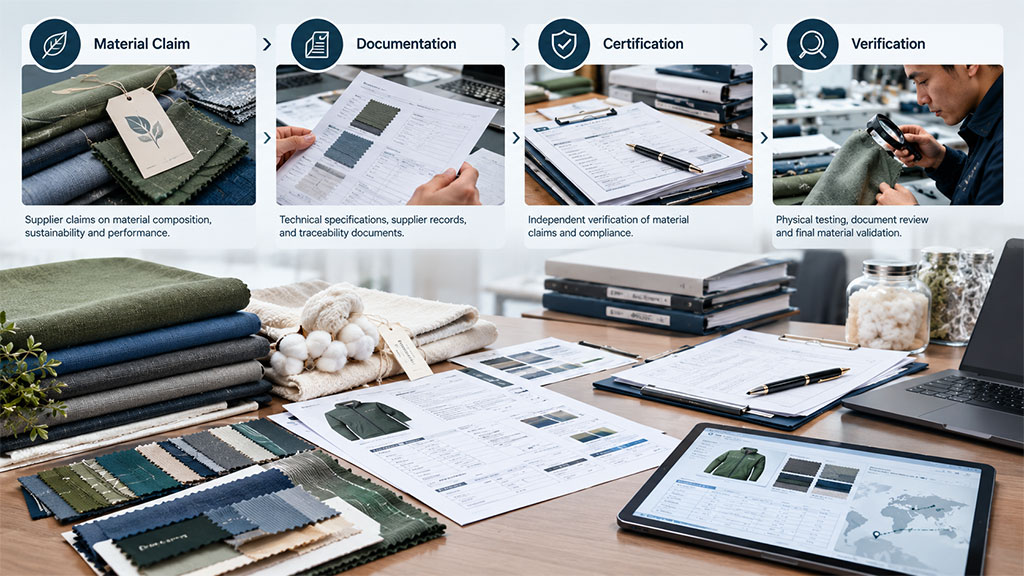
2. Verify Material Claims and Certifications
Claims such as “recycled fabric,” “organic cotton,” or “eco-friendly polyester” should be supported by appropriate documentation.
Depending on the material and claim, buyers may encounter:
- GRS — Global Recycled Standard
- GOTS — Global Organic Textile Standard
- OEKO-TEX — textile-related chemical and product safety systems
- FSC — relevant to certain forest-based or cellulosic materials
These certifications are not interchangeable. Recycled-content verification, organic-fiber certification, chemical requirements, and responsible sourcing address different issues.
B2B buyers should verify:
| Verification Area | What to Check |
|---|---|
| Material | Fiber composition and sourcing |
| Recycled Content | Supporting evidence |
| Certification | Issuer, scope, and validity |
| Supplier | Relevant production and material information |
| Testing | Chemical, safety, and performance requirements |
3. Reduce Fabric Waste During Cutting
Sustainability also depends on how efficiently fabric is used.
Factories can reduce cutting waste through:
- Optimized marker layouts
- Accurate pattern grading
- Digital pattern planning
- Efficient fabric utilization
- Better nesting of pattern pieces
- Reuse of suitable cutting remnants
For large production orders, even a small improvement in material utilization can become commercially significant.
This creates a direct connection between waste reduction and production cost control.
4. Design for Durability
Product longevity is another important part of responsible apparel manufacturing.
Garment durability can be influenced by:
- Fabric selection
- Seam construction
- Stitch quality
- Reinforcement
- Zipper and button quality
- Stress-point construction
- Wash durability
This is particularly important for outdoor jackets, workwear, and performance apparel.
A sustainable material does not compensate for poor construction or a short usable life. Reliable quality, fewer defects, fewer returns, and longer product use can all contribute to a more responsible product lifecycle.
5. Control Water, Chemicals and Finishing Processes
Textile processing can involve dyeing, washing, printing, finishing, and coating. These processes may require water, energy, and chemicals.
When evaluating a manufacturer, B2B buyers can ask:
- How are dyes and chemicals managed?
- Are wastewater treatment systems used where applicable?
- Are chemical-management requirements documented?
- What testing is performed on finished fabrics?
- Are restricted-substance requirements followed?
For specialized garments using printing, coating, waterproofing, or other finishes, requirements can vary significantly by process.
6. Reduce Production and Sampling Waste
Manufacturing waste can include fabric offcuts, thread waste, packaging, defective garments, sample waste, paper, and plastic materials.
Suitable waste-management systems can support reuse, recycling, material recovery, and responsible disposal where practical.
Product development should also be reviewed.
Every physical sample consumes fabric, trims, thread, labels, packaging, and transportation resources. Brands should not eliminate necessary samples, but they can reduce avoidable sample iterations by resolving straightforward issues through:
- Digital measurements
- Technical drawings
- Detailed comments
- Digital artwork review
- Video communication
- Shared specification documents
The objective is simple: make every physical sample purposeful.
7. Build Sustainability Into the Tech Pack
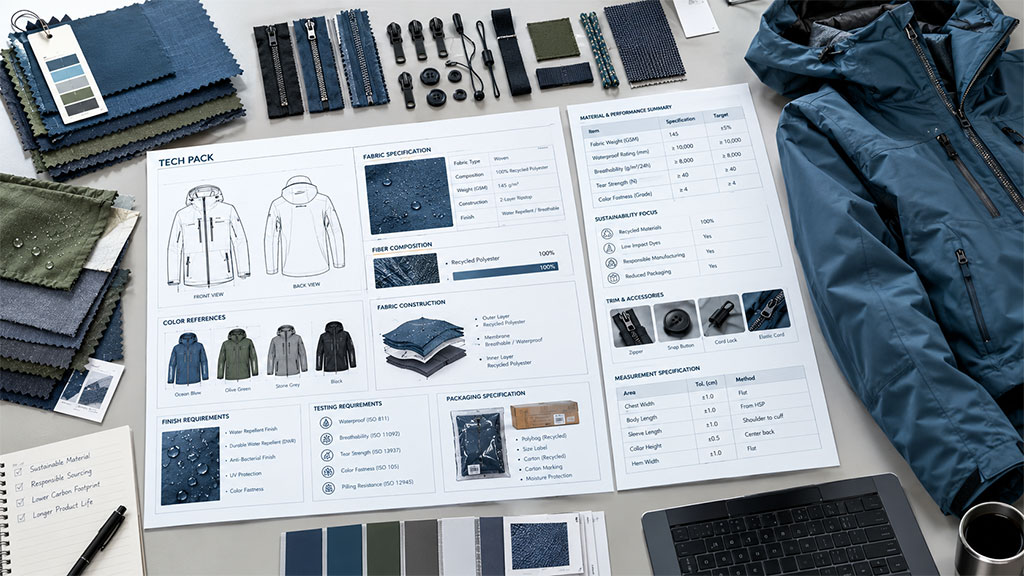
One of the most practical steps is to turn sustainability goals into measurable product specifications.
Instead of simply specifying “use eco-friendly fabric,”
a B2B tech pack can define:
- Fiber composition
- Recycled-content requirements
- Certification
requirements - GSM
- Fabric construction
- Color
- Finish
- Testing requirements
- Packaging requirements
This gives the manufacturer a measurable target and makes sustainability easier to verify during production.
A detailed tech pack therefore acts as a bridge between a brand’s sustainability objectives and actual manufacturing requirements.
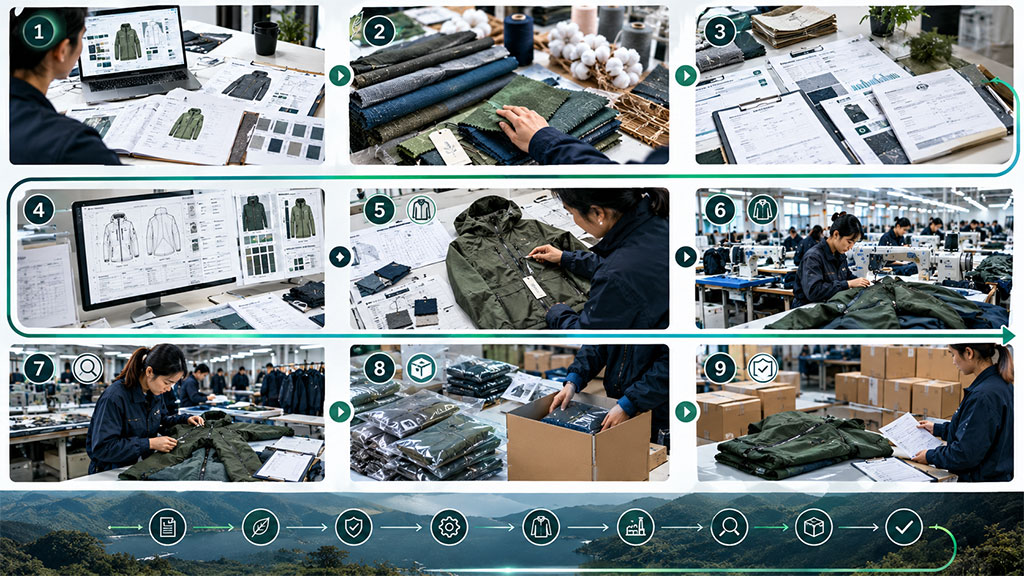
Sustainable OEM Apparel Manufacturing Workflow
For an OEM apparel project, a practical workflow can include:
1. Product Brief → 2. Material Selection → 3. Certification & Documentation → 4. Product Development → 5. Sampling → 6. Bulk Production → 7. Quality Control → 8. Packaging → 9. Final Inspection
At each stage, sustainability requirements should remain connected to product performance, cost, quality, and manufacturing feasibility.
For example, identifying a recurring sewing defect during production can prevent large-scale rework or rejection later. This makes in-line quality control relevant not only to product quality but also to material and production efficiency.
Common Challenges for B2B Buyers
Eco-friendly manufacturing can involve practical trade-offs.
Higher material costs: Some certified or recycled materials may cost more depending on supply, quality, certification, and order volume.
Limited availability: A sustainable fabric may not be available in the required color, GSM, width, quantity, or performance level.
Certification complexity: Different materials and claims require different certification systems.
Performance trade-offs: Sustainable materials still need to meet functional requirements, particularly for outdoor and technical apparel.
Supply-chain transparency: Multiple suppliers and processing stages can make material traceability more difficult without appropriate documentation.
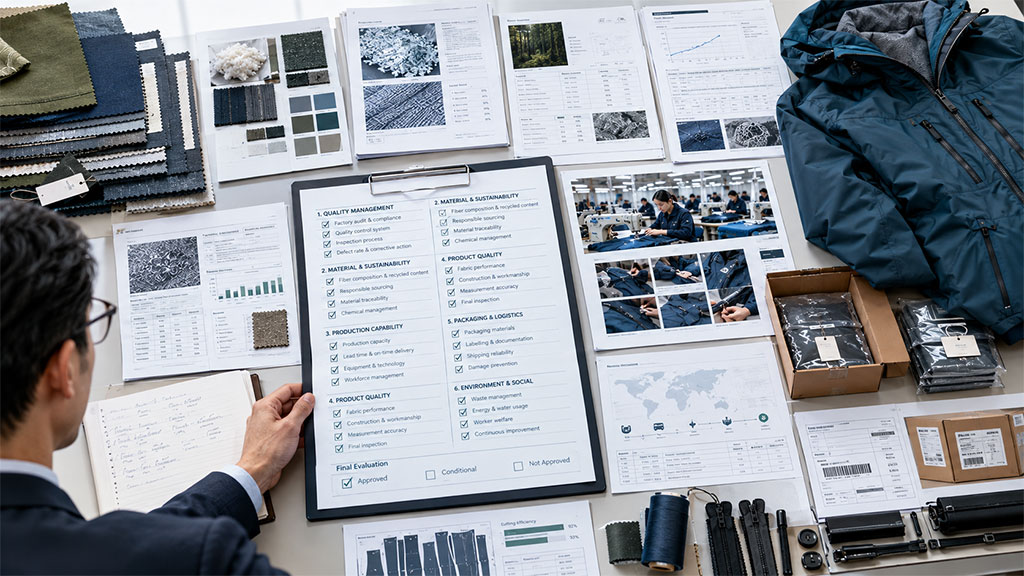
B2B Buyer Checklist
Before placing a bulk order, buyers should review:
| Area | What to Check |
|---|---|
| Fabric | Fiber composition and sourcing |
| Recycled Content | Supporting documentation |
| Certification | Relevant and valid certification |
| Dyeing & Finishing | Chemical and process requirements |
| Cutting | Material utilization and waste |
| Production | Defect and rework management |
| Quality | In-line and final QC |
| Packaging | Material use and efficiency |
| Traceability | Supplier and material documentation |
| Product Life | Durability and performance |
This approach transforms sustainability from a broad marketing claim into a practical manufacturing requirement.
FAQ
1.What is eco-friendly apparel manufacturing?
Eco-friendly apparel manufacturing refers to producing garments through practices intended to reduce environmental impact across materials, processing, production, waste management, packaging, and product lifecycle considerations.2.What fabrics are commonly used for eco-friendly apparel?
Common options include recycled polyester, recycled nylon, organic cotton, recycled cotton, linen, hemp, and certain responsibly sourced cellulosic fibers. The appropriate material depends on performance, durability, cost, and target-market requirements.3.How can buyers verify recycled fabric claims?
Buyers should request supporting documentation and relevant certification where applicable. For recycled materials, GRS can provide a stronger basis for verifying recycled-content claims than an unsupported supplier statement.4.Is organic cotton automatically more sustainable?
Not necessarily. Organic cotton addresses specific aspects of fiber production, but overall environmental impact also depends on processing, dyeing, transportation, durability, manufacturing efficiency, and product use.5.What certifications should apparel buyers look for?
The appropriate certification depends on the material and claim. Common standards include GOTS for organic textiles, GRS for recycled materials, OEKO-TEX systems for textile-related chemical and product safety requirements, and FSC for certain forest-based materials and supply chains.6.Can eco-friendly apparel be produced through OEM manufacturing?
Yes. OEM manufacturers can develop and produce garments using specified sustainable or recycled materials when the required fabrics, trims, certifications, testing, and production requirements are available and clearly defined.7.Does sustainable apparel manufacturing cost more?
It can, but not always. Cost depends on material selection, certification, order quantity, construction, processing, packaging, and supplier availability. Sustainability decisions should therefore be evaluated together with target product cost and performance.8.How can apparel factories reduce environmental waste?
Factories can reduce waste through better fabric utilization, optimized cutting, fewer unnecessary sample rounds, production defect reduction, rework control, material reuse or recycling, efficient packaging, and appropriate waste-management systems.Conclusion
Eco-friendly apparel manufacturing is a system rather than a single material choice.
For B2B apparel brands, a practical approach combines suitable lower-impact materials with verified documentation, efficient cutting, responsible production, chemical and process control, purposeful sampling, appropriate packaging, strong quality control, and durable product design.
The most important principle is evidence-based sustainability.
Rather than relying on broad claims such as “green” or “eco-friendly,” buyers should define measurable requirements and request appropriate documentation, certifications, testing, and production information.
When sustainability is integrated into the tech pack, sourcing process, sampling workflow, quality-control system, and bulk manufacturing process, environmental objectives become clearer, more measurable, and more practical for OEM apparel production.
Written by the Simmerui Apparel Manufacturing Team
We specialize in OEM and ODM apparel production for global B2B brands, providing integrated solutions across product development, fabric sourcing, sampling, quality control, and scalable manufacturing. Our experience covers outdoor apparel, performance wear, casual clothing, and private label collections.
We help brands reduce production risks, optimize costs, and build reliable long-term manufacturing partnerships.