
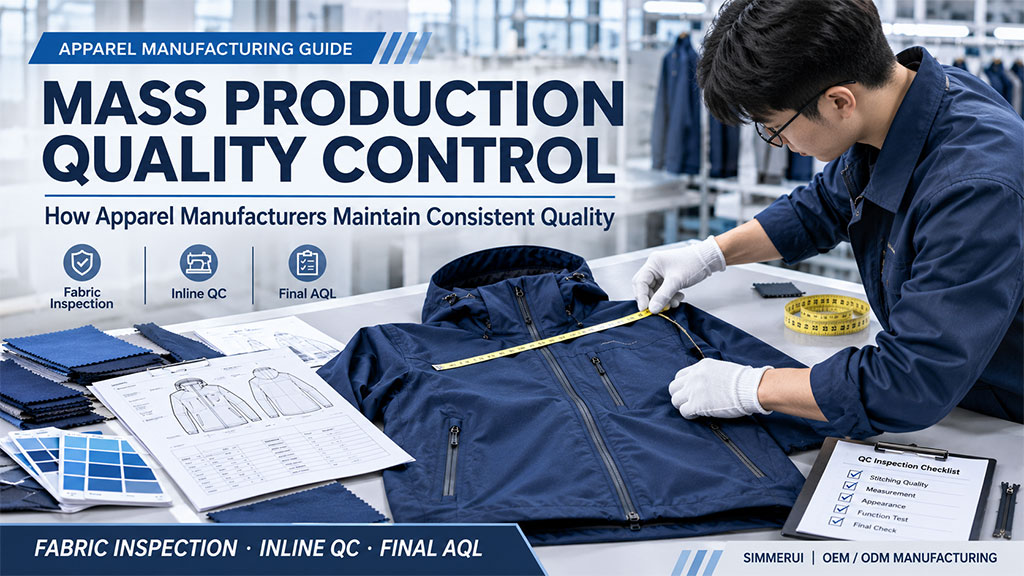
Apparel manufacturers control quality during mass production through a structured inspection system covering materials, cutting, sewing, finishing, and final packaging. Effective quality management combines approved pre-production samples (PPS), incoming material inspection, inline quality control, measurement verification, defect management, and final AQL inspection. For B2B clothing brands, these procedures help reduce manufacturing defects, maintain product consistency, prevent costly rework, and ensure bulk orders meet approved specifications.
1. Why Quality Control Matters in Mass Apparel Production
Moving from sample development to mass production introduces greater manufacturing complexity. A garment that meets expectations during sampling does not automatically guarantee consistent quality across hundreds or thousands of units. Common production issues include:- Fabric shade variations between production batches.
- Incorrect garment measurements and inconsistent sizing.
- Uneven stitching and poor seam construction.
- Misplaced logos, labels, or accessories.
- Finishing and packaging defects.
2. Establish Quality Standards Before Bulk Production
Consistent manufacturing starts with clearly documented product requirements.
Approve the Pre-Production Sample (PPS)
The approved Pre-Production Sample (PPS) serves as the physical reference for bulk manufacturing.
Before production begins, manufacturers and buyers should confirm:
- Fabric composition, weight, and color.
- Garment measurements and tolerances.
- Stitching methods and construction details.
- Zippers, buttons, and accessories.
- Logo placement and branding.
- Labels and packaging requirements.
The approved PPS should remain accessible to production supervisors and QC inspectors throughout manufacturing.
Finalize the Tech Pack and Measurement Specifications
A complete tech pack translates design requirements into production instructions. It should include technical drawings, Bill of Materials (BOM), Points of Measurement (POM), construction details, grading specifications, and measurement tolerances.
For technical outdoor apparel, additional requirements may cover seam sealing, waterproof zippers, hood construction, and ventilation details.
Clear specifications reduce interpretation errors and help different production teams follow consistent standards.
3. Conduct Incoming Fabric and Material Inspection
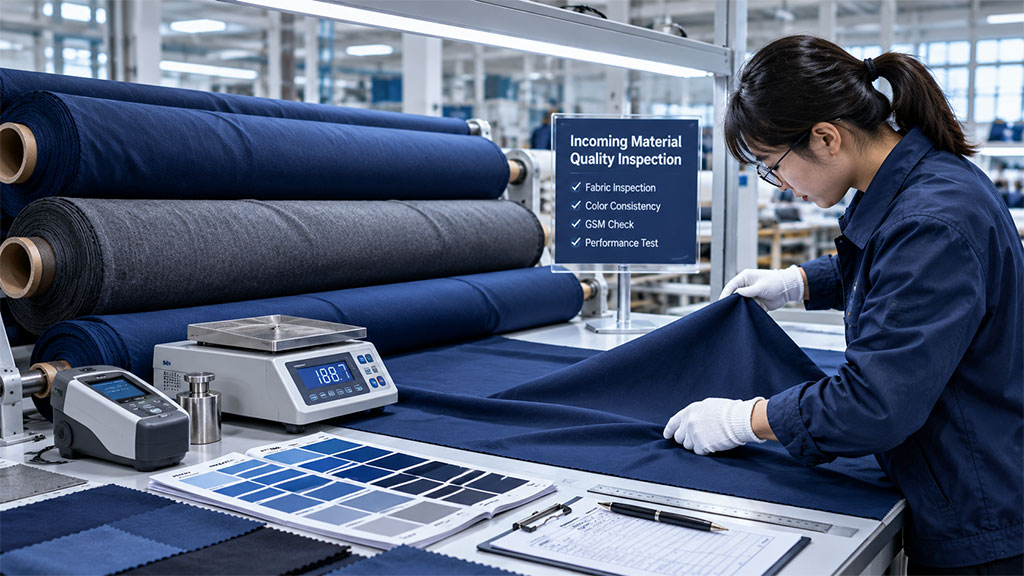
Fabric quality directly affects garment appearance, durability, comfort, and performance. Even approved materials should undergo bulk inspection before cutting.
| Inspection Item | Quality Control Focus |
|---|---|
| Fabric Appearance | Holes, stains, weaving defects, and surface irregularities |
| Color Consistency | Shade differences between rolls |
| Fabric Weight | GSM consistency |
| Fabric Width | Actual usable width |
| Shrinkage | Dimensional changes after testing |
| Colorfastness | Resistance to fading and color transfer |
| Performance | Tensile, tear, abrasion, or waterproof performance where required |
Identifying material defects before cutting helps prevent widespread production problems, reduce fabric waste, and minimize unnecessary rework.
For technical apparel, additional material testing may be required to verify specific performance specifications.
4. Control Cutting Accuracy and Panel Consistency
Cutting accuracy directly influences garment measurements, panel alignment, and final fit.
Manufacturers should establish three essential checkpoints:
- Fabric Spreading: Check fabric alignment, tension, wrinkles, and layer consistency.
- Pattern Verification: Confirm cutting markers and patterns match approved specifications.
- Cut Panel Inspection: Check dimensions, edges, fabric defects, print alignment, quantities, and shade grouping.
For outdoor jackets, color-blocked garments, and printed apparel, accurate panel matching is particularly important.
Early cutting inspection prevents small errors from affecting large production quantities.
5. Implement Inline Quality Control During Sewing
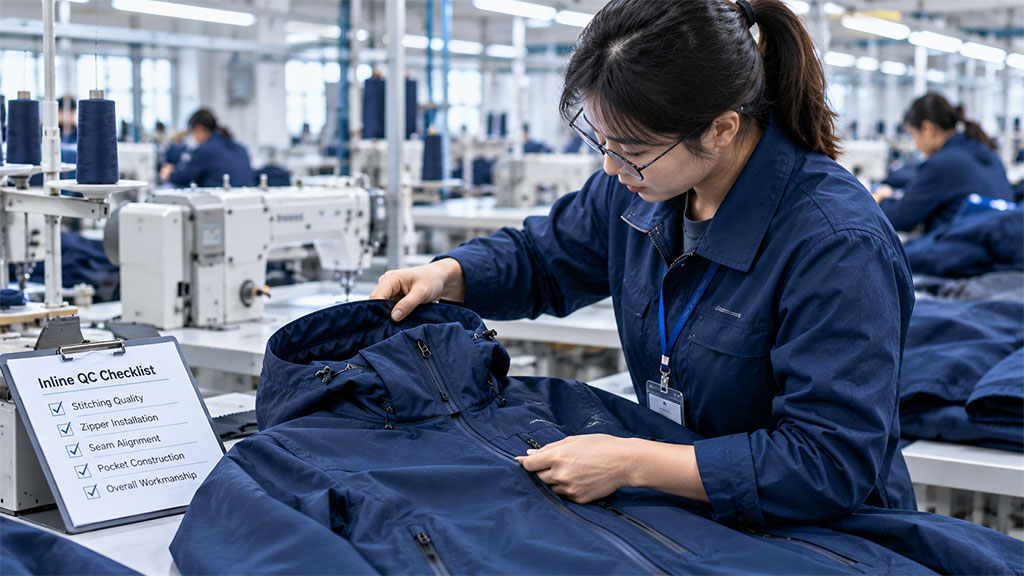
Inline quality control (Inline QC) allows manufacturers to identify defects while garments are being assembled instead of waiting until production is complete.
What Do Inspectors Check?
| QC Checkpoint | Inspection Focus |
|---|---|
| Stitching | Stitch density, skipped stitches, loose threads, and broken seams |
| Seam Construction | Seam allowance, alignment, and consistency |
| Measurements | Key dimensions and tolerances |
| Zippers | Alignment, attachment, and smooth operation |
| Pockets | Position, dimensions, and symmetry |
| Logo Application | Embroidery, printing, and placement |
| Functional Details | Buttons, snaps, drawcords, and accessories |
First-Piece and Mid-Production Inspection
Before a production line reaches full capacity, the first completed garments should be checked against the approved PPS.
During bulk production, inspectors should continue monitoring workmanship and recurring defects.
For example, repeated uneven sleeve seams may indicate incorrect machine settings, operator techniques, or unclear sewing instructions.
The objective is not simply to repair defective garments but to identify root causes and prevent recurring problems.
6. Maintain Measurement and Size Consistency
Incorrect measurements are among the most common concerns in bulk apparel manufacturing. To maintain consistent sizing, manufacturers should:- Follow one approved measurement chart.
- Define acceptable tolerances for each POM.
- Inspect multiple sizes across the size range.
- Record measurement deviations.
- Investigate recurring problems in patterns, cutting, and sewing.
7. Classify Defects and Implement Corrective Actions
Not all garment defects have the same impact. A structured classification system helps manufacturers prioritize quality issues.| Defect Category | Typical Examples |
|---|---|
| Critical | Dangerous components, serious safety failures, or regulatory violations |
| Major | Broken zippers, open seams, or measurements beyond agreed tolerances |
| Minor | Loose threads and small cosmetic irregularities |
- Identify and record the defect.
- Determine the affected production quantity.
- Investigate the root cause.
- Implement corrective measures.
- Reinspect repaired or affected garments.
- Monitor subsequent production.
8. Perform Final Garment Inspection and AQL Quality Control
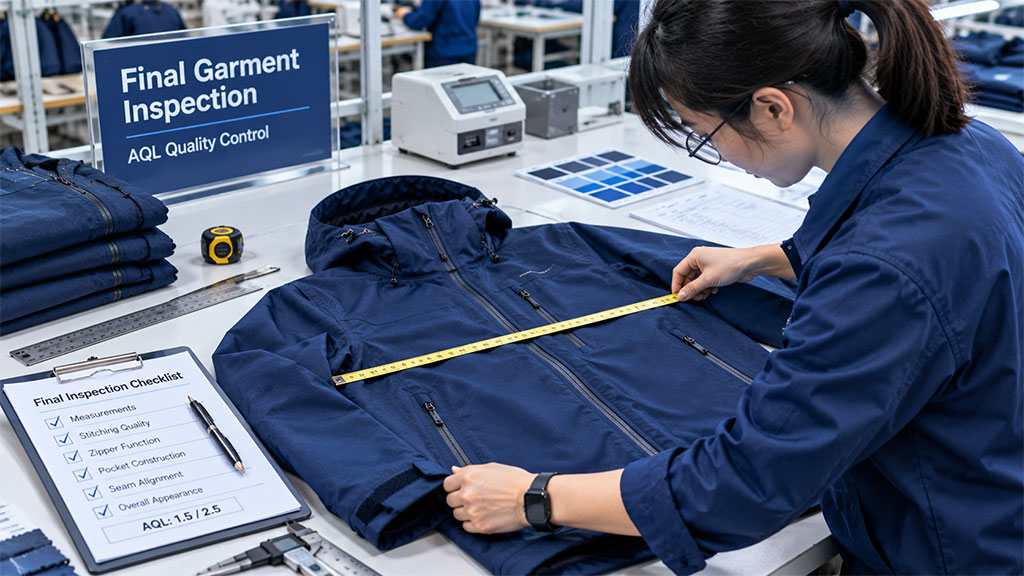
After sewing, assembly, and finishing, garments undergo final inspection before shipment.
AQL (Acceptable Quality Limit) inspection is widely used in B2B apparel manufacturing to evaluate production lots through statistical sampling.
What Does Final Inspection Cover?
- Overall appearance and workmanship.
- Fabric condition and color consistency.
- Measurements and size accuracy.
- Stitching and seam construction.
- Zipper and accessory functionality.
- Printing and embroidery quality.
- Brand and care labels.
- Folding, polybags, and packaging.
- Carton quantities and shipping marks.
AQL Inspection vs. 100% Inspection
| Inspection Method | Main Approach | Application |
|---|---|---|
| AQL Inspection | Random sampling | Routine bulk order evaluation |
| 100% Inspection | Every garment is checked | High-risk products or targeted defect sorting |
| Inline Inspection | Checks during manufacturing | Early defect detection |
| Final Inspection | Evaluates completed garments | Pre-shipment verification |
AQL 2.5 is commonly used as a reference for major defects in apparel inspection plans. However, it does not mean that 2.5% of the entire order is automatically allowed to be defective.
Acceptance decisions depend on the agreed sampling standard, inspection level, sample size, and acceptance criteria.
AQL should complement, not replace, in-process quality control.
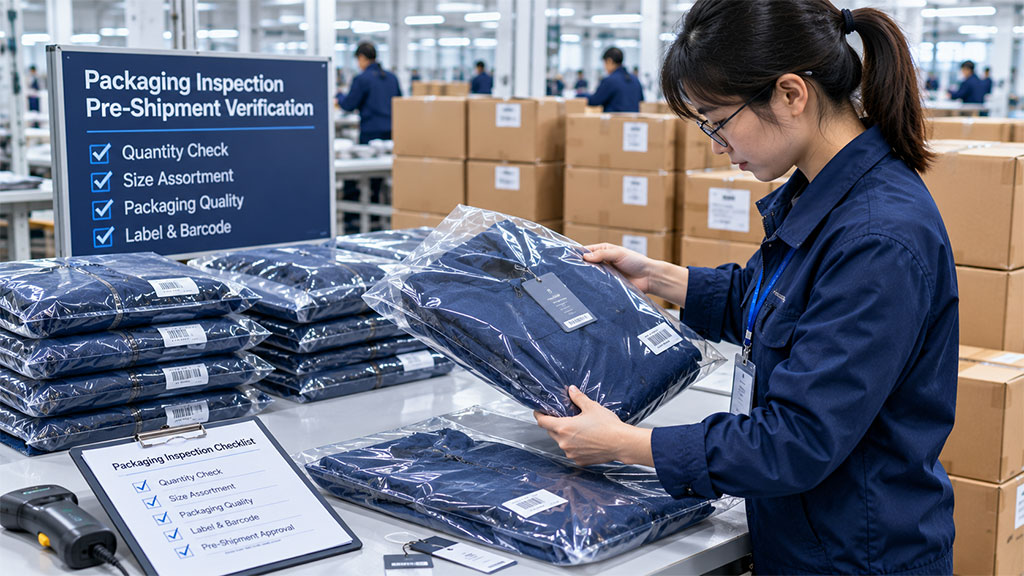
9. Verify Packaging Before Shipment
Packaging errors can create receiving problems for retailers, distributors, and international warehouses. Before shipment, manufacturers should verify:| Inspection Area | Key Requirements |
|---|---|
| Folding | Approved folding method |
| Polybags | Correct size and material |
| Size Labels | Accurate size identification |
| Hangtags | Correct branding and product information |
| Barcodes | Accurate SKU and barcode information |
| Size Assortment | Correct quantities by size |
| Carton Packing | Correct quantities and arrangement |
| Carton Marks | Accurate shipping information |
10. Build a Consistent Apparel Quality Management System
Reliable quality control requires coordination between product development, material sourcing, production, and inspection teams.
| Manufacturing Stage | Main QC Responsibility |
|---|---|
| Product Development | Confirm tech packs and specifications |
| PPS Approval | Establish approved production references |
| Material Inspection | Verify fabrics and accessories |
| Cutting | Check patterns and panel dimensions |
| Sewing & Assembly | Monitor stitching and workmanship |
| Inline QC | Identify and correct production defects |
| Finishing | Verify appearance and functionality |
| Final Inspection | Conduct AQL or agreed inspections |
| Packing | Verify labels and carton requirements |
Track Quality Performance Through Production Records
Manufacturers can monitor production consistency using measurable quality indicators:
- Defect Rate: Proportion of inspected units or operations failing requirements.
- Rework Rate: Proportion of garments requiring repair or correction.
- First-Pass Yield: Proportion of units passing inspection without rework.
- Recurring Defect Frequency: Frequency of repeated production issues.
- Inspection Pass Rate: Proportion of lots or inspections meeting agreed criteria.
These records help production managers identify quality trends, evaluate corrective actions, and improve manufacturing performance.
11. Common Quality Control Mistakes to Avoid
Even established manufacturers can experience quality problems when inspection procedures are poorly implemented.| Common Mistake | Better Approach |
|---|---|
| Relying only on final inspection | Combine material checks, inline QC, and final inspection |
| Using incomplete tech packs | Finalize specifications and measurement tolerances |
| Ignoring fabric batch differences | Inspect and approve bulk materials before cutting |
| Failing to document defects | Maintain defect records and corrective-action reports |
| Treating AQL as a quality guarantee | Integrate AQL into a broader QC system |
12. How B2B Apparel Brands Can Work with Manufacturers to Improve Quality
Quality control is a shared responsibility between apparel brands and manufacturing partners. Before starting bulk production, buyers should confirm:Product Specifications
- Final tech pack and BOM.
- Approved measurement chart.
- Construction and workmanship requirements.
- Fabric and trim specifications.
Sample Approval
- Approved PPS.
- Confirmed size set where required.
- Final color and branding approval.
- Documented revision comments.
Quality Standards
- Agreed defect classification.
- Measurement tolerances.
- Required material and performance tests.
- Inline and final inspection procedures.
- AQL sampling plan and acceptance criteria.
Production Communication
- Production schedule and milestones.
- Regular inspection updates.
- Defect reporting and corrective actions.
- Final inspection and packing confirmation.
FAQ: Apparel Manufacturing Quality Control
1. How do apparel manufacturers control quality during mass production?
They use incoming material inspection, PPS approval, cutting checks, inline QC, measurement verification, defect monitoring, final garment inspection, and AQL sampling.2. What are the main quality control stages in garment manufacturing?
The main stages include material inspection, sample approval, cutting, sewing, assembly, finishing, final inspection, and packaging verification.3. What is inline quality control in apparel manufacturing?
Inline QC involves inspecting garments during production to identify stitching, measurement, construction, and workmanship defects before they affect large quantities.4. What is AQL in garment quality inspection?
AQL stands for Acceptable Quality Limit. It is a statistical sampling approach used to evaluate whether a production lot meets agreed acceptance criteria.5. Is AQL inspection enough to ensure garment quality?
No. AQL evaluates sampled garments and cannot guarantee that every unit is defect-free. It should be combined with material inspection, PPS approval, and inline QC.6. What are common defects in mass apparel production?
Common defects include incorrect measurements, uneven stitching, open seams, fabric stains, color variations, broken zippers, misplaced logos, and packaging errors.7. How can clothing brands reduce quality problems during bulk production?
Brands should provide complete tech packs, approve PPS samples, confirm material specifications, define measurement tolerances, and establish clear inspection procedures.8. When should apparel manufacturers conduct quality inspections?
Inspections should begin before bulk production and continue through material preparation, cutting, sewing, assembly, finishing, and final shipment verification.9. What is the difference between QA and QC in apparel manufacturing?
Quality Assurance (QA) establishes systems and procedures to prevent defects. Quality Control (QC) inspects materials and finished products to identify whether they meet defined requirements.10. What should B2B buyers ask an apparel manufacturer about quality control?
Buyers should ask about material inspection, PPS approval, inline inspection frequency, measurement tolerances, defect classification, AQL standards, corrective actions, and inspection documentation.Conclusion: Consistent Quality Starts Before Mass Production
Reliable apparel quality cannot be achieved through final inspection alone. It requires a structured manufacturing system covering materials, specifications, workmanship, measurements, and finished products throughout production.
For B2B clothing brands, working with an OEM or ODM manufacturing partner that integrates quality control into every production stage helps reduce manufacturing risks, maintain product consistency, and build a more reliable supply chain.
At Simmerui, we understand that reliable apparel manufacturing starts with clear specifications and continues throughout every production stage. Our integrated approach combines product development, fabric sourcing, sampling, quality control, and scalable OEM/ODM manufacturing to support global B2B apparel brands.
Written by the Simmerui Apparel Manufacturing Team
The Simmerui Apparel Manufacturing Team specializes in OEM and ODM apparel production for global B2B brands, providing integrated solutions across product development, fabric sourcing, sampling, quality control, and scalable manufacturing. Our experience covers outdoor apparel, performance wear, casual clothing, and private label collections. We help brands reduce production risks, optimize costs, and build reliable long-term manufacturing partnerships.