
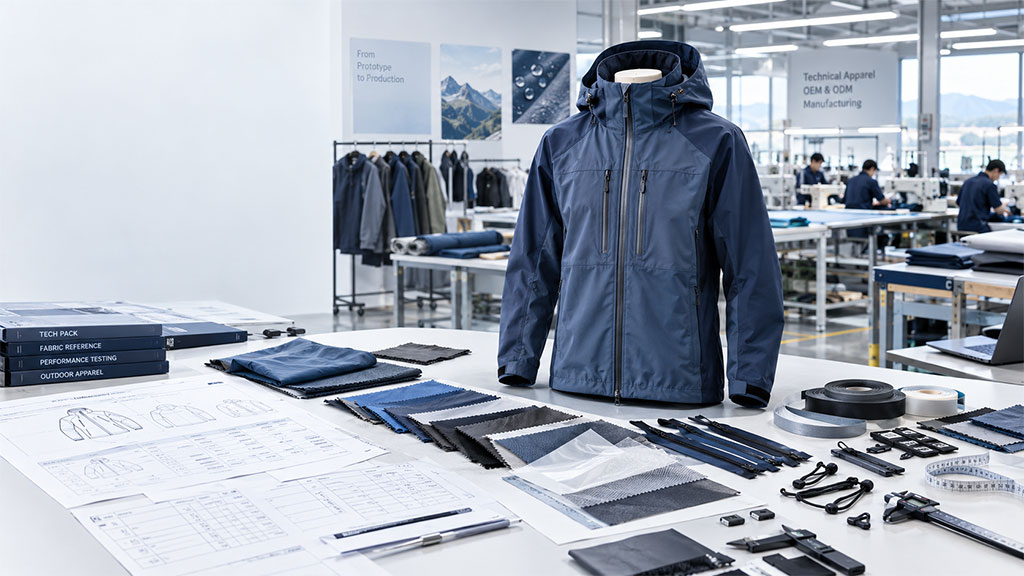
Outdoor apparel development turns a product concept into a production-ready garment through technical specifications, material selection, pattern development, prototyping, fit evaluation, performance testing, PPS approval, and bulk manufacturing.
For B2B outdoor brands, a structured outdoor apparel OEM manufacturing process helps control quality, production costs, compliance risks, and lead times. The goal is not simply to create a successful prototype, but to establish a repeatable product standard that can be manufactured consistently at commercial scale.
Introduction: Turn an Outdoor Apparel Concept Into a Production-Ready Product
Developing outdoor apparel is more complex than producing a basic fashion garment. An outdoor jacket, technical shell, insulated coat, hiking layer, or performance garment may need to balance:- Weather protection
- Breathability
- Durability
- Weight
- Mobility
- Thermal performance
- Fabric performance
- Construction quality
- Brand aesthetics
- Regulatory requirements
- Target production cost
1. Define Product Requirements Before Sampling
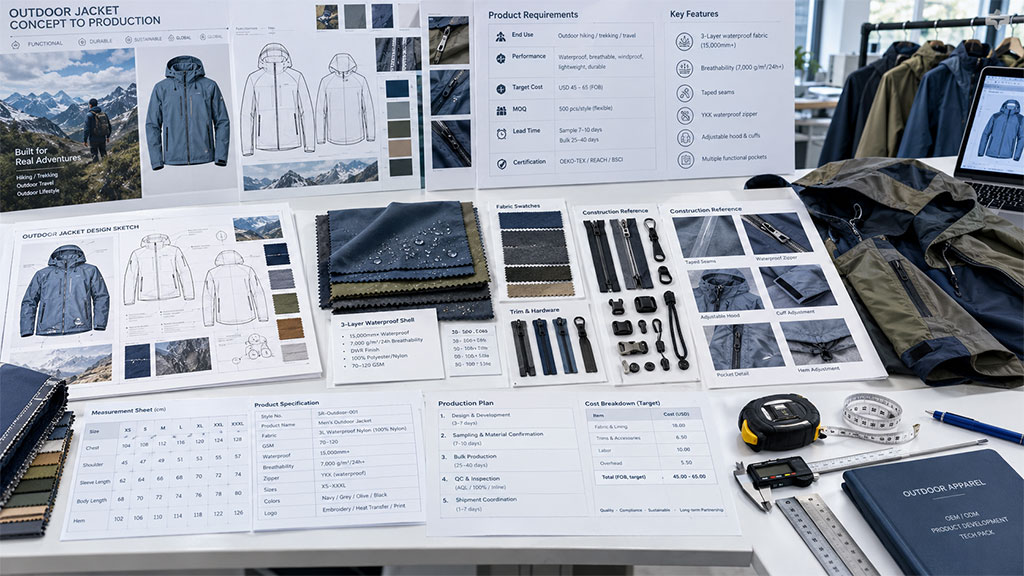
Every outdoor apparel development process begins with a clear product concept. Before sampling starts, the brand and manufacturer should define the intended market, end use, design direction, performance requirements, target cost, and expected production volume. For example, a technical shell jacket may be developed around:| Requirement | Example |
|---|---|
| Product Type | Waterproof Outdoor Shell Jacket |
| Target Market | Hiking / Outdoor Performance |
| Fabric | 3-Layer Technical Shell |
| Performance | Waterproof + Breathable |
| Construction | Seam-Sealed |
| Closure | Waterproof Front Zipper |
| Hood | Adjustable / Helmet Compatible |
| Target Volume | Bulk OEM Production |
| Branding | Custom Labels + Logo |
| Target Cost | Defined Before Sampling |
2. Build the Tech Pack and Technical Specifications
Once product requirements are defined, the next step is translating the design into manufacturing information.
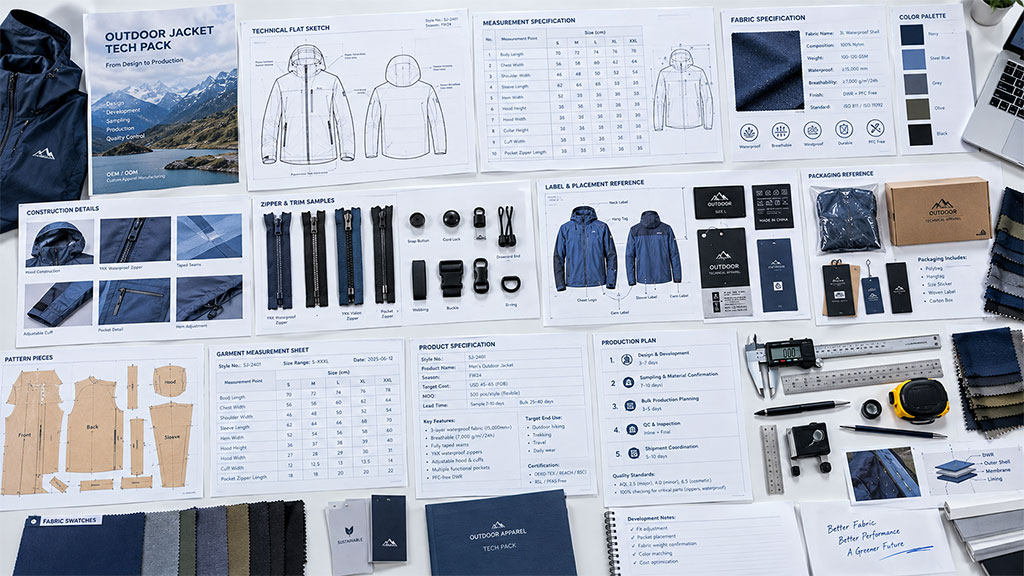
A detailed tech pack normally includes:
- Flat sketches
- Garment measurements
- Construction details
- Fabric specifications
- Color references
- Trim information
- Label placement
- Stitching requirements
- Zipper specifications
- Packaging requirements
- Measurement tolerances
For technical outdoor apparel, the specification may also include waterproof ratings, breathability targets, seam-sealing requirements, abrasion resistance, and applicable fabric testing requirements.
The purpose of the tech pack is to reduce interpretation differences between the brand and manufacturer.
For outdoor apparel OEM manufacturing, accurate technical specifications create the reference point for sampling, production, and QC.
3. Select and Validate Fabrics and Materials
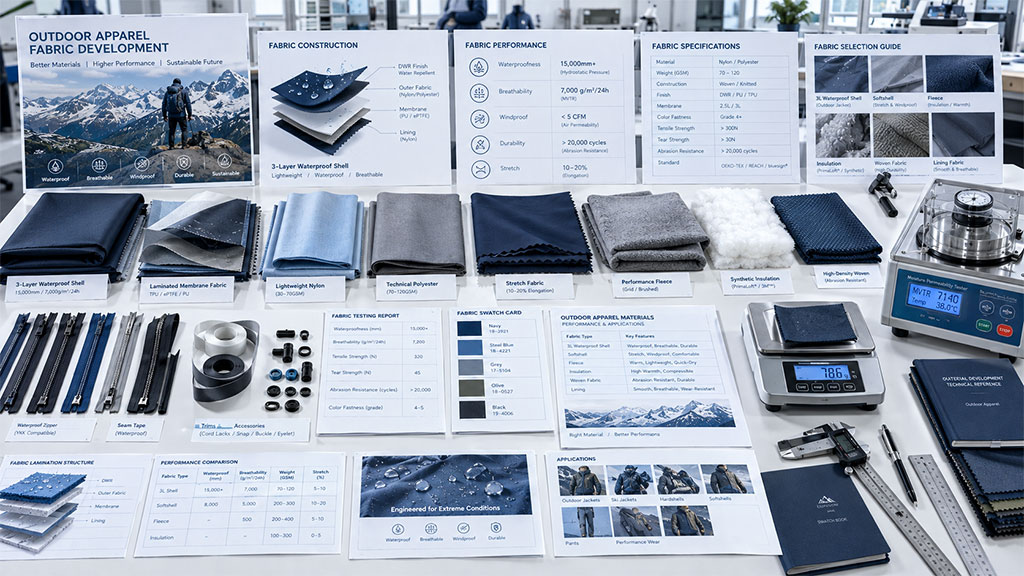
Fabric selection should be based on the intended use of the garment rather than appearance alone.
Different outdoor products require different material considerations:
| Product Requirement | Possible Material Consideration |
|---|---|
| Waterproof Shell | Laminated / membrane fabric |
| Breathability | Moisture-vapor-permeable construction |
| Lightweight Performance | Lightweight nylon or polyester |
| Insulation | Synthetic insulation or down |
| Stretch | Elastane-blended fabric |
| Durability | High-density woven fabric |
| Soft Outdoor Layer | Performance fleece |
| Moisture Management | Technical synthetic or blended fabric |
Fabric performance must also be considered together with garment construction.
For example, a high-performance membrane cannot compensate for poor seam construction or inappropriate garment design.
This is why material development should be connected with fabric testing, sample construction, and final product testing rather than treated as an isolated sourcing decision.
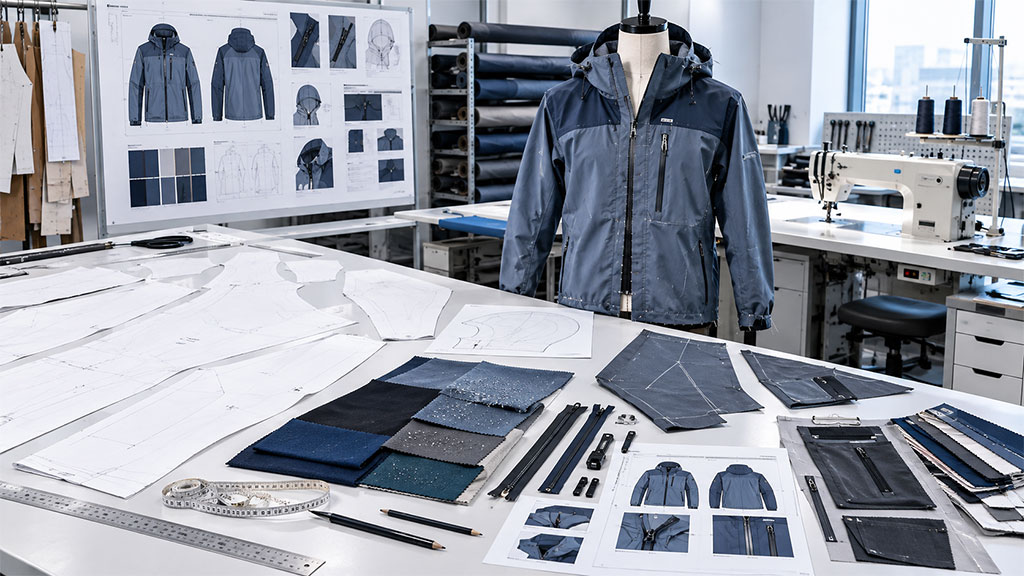
4. Develop the Pattern and First Outdoor Apparel Prototype
After materials and technical requirements are established, the manufacturer develops the initial pattern and first prototype.
The first sample verifies the relationship between:
Design → Pattern → Fabric → Construction
During prototype development, the team evaluates:
- Overall silhouette
- Garment proportions
- Panel configuration
- Sleeve construction
- Hood shape
- Pocket positioning
- Zipper placement
- Seam construction
- Fabric behavior
- Basic functionality
The first prototype does not necessarily need to be production-ready.
Its purpose is to create a physical reference that exposes problems that may not be visible in technical drawings.
For technical outdoor products, this stage is particularly important because fabric behavior, mobility, construction, and component interaction are easier to evaluate on a physical garment.
5. Improve Fit Through Structured Sample Revision
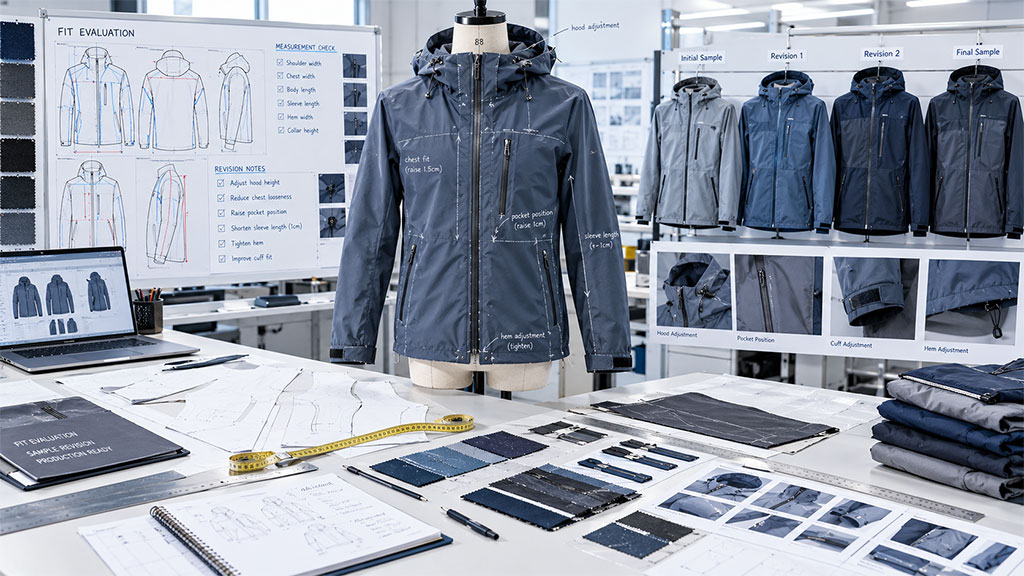
Outdoor apparel often requires multiple rounds of sampling.
A basic T-shirt may need relatively few revisions, while a technical outdoor jacket can require several rounds because of more complex construction and performance requirements.
A typical development sequence is:
Prototype → Brand Review → Fit Comments → Pattern Adjustment → Revised Sample → Performance Review → PPS
Typical revisions may involve:
- Chest width
- Body length
- Sleeve length
- Shoulder construction
- Hood dimensions
- Pocket position
- Cuff opening
- Hem adjustment
- Seam placement
- Garment mobility
Feedback should be documented during every round rather than relying only on verbal communication.
This creates a traceable development record and reduces the risk of repeating previous mistakes.
6. Verify Outdoor Apparel Performance Through Testing
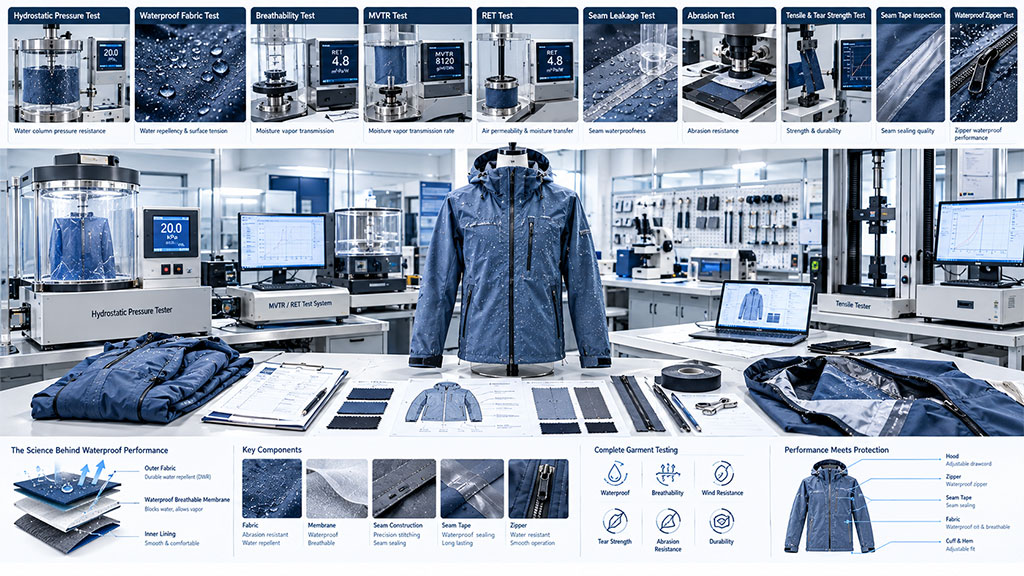
Once the basic fit and construction are established, performance testing becomes increasingly important.
Depending on the product category, testing may include:
- Waterproof testing
- Hydrostatic pressure testing
- Breathability testing
- MVTR testing
- RET testing
- Seam leakage testing
- Abrasion testing
- Tear strength testing
- Tensile strength testing
- Colorfastness testing
- Shrinkage testing
For waterproof outdoor apparel, testing should not focus only on the fabric.
The complete garment may need to be evaluated as:
Fabric + Membrane + Seam Construction + Seam Tape + Zippers + Garment Assembly
A strong fabric specification does not automatically guarantee a waterproof finished garment.
The final performance depends on how the materials and construction work together.
7. Approve the PPS Before Bulk Production
After major design, fit, construction, and performance issues have been resolved, the development process moves toward the Pre-Production Sample (PPS).
The PPS should represent how the garment will actually be manufactured in bulk.
It should reflect the approved:
- Fabric
- Color
- Pattern
- Measurements
- Construction
- Trims
- Labels
- Branding
- Stitching
- Functional details
- Packaging requirements
The PPS is critical because it becomes a reference point for both production and quality control.
A production order should not rely on an early prototype when a more complete and approved PPS has been established.
8. Finalize Measurements and Size Grading
A production-ready garment requires more than one approved sample.
The manufacturer must establish how measurements change across the complete size range:
XS → S → M → L → XL → XXL
Size grading should maintain the intended proportions of the original design rather than simply applying the same measurement increment to every point.
The production specification should define:
- Points of measurement
- Base size
- Grading increments
- Measurement tolerance
- Measurement method
- Size range
These specifications later become part of production QC.
A garment can look correct in one sample size while still having inconsistent grading across the complete production range.
9. Translate the Approved Product Into Bulk Manufacturing
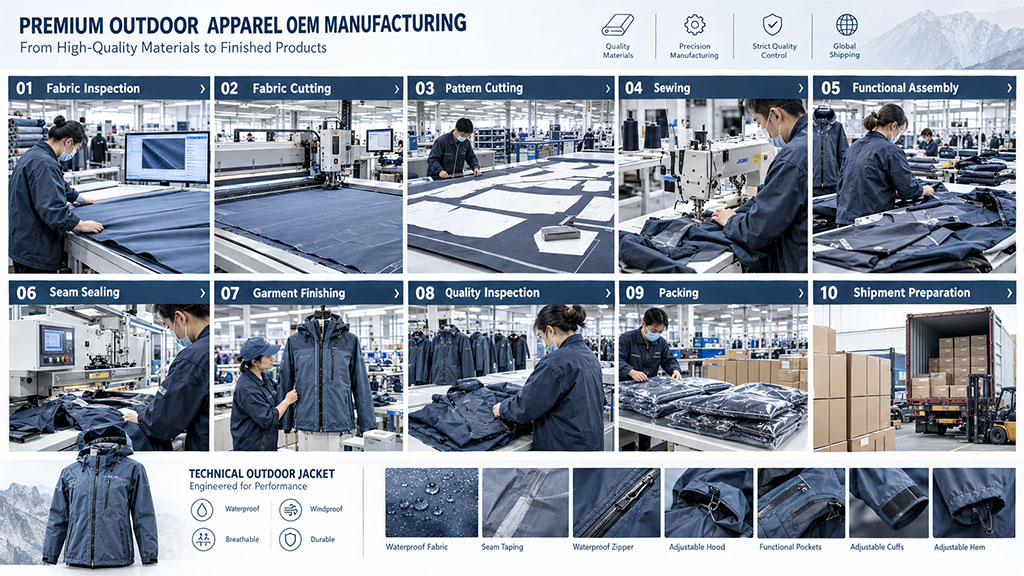
Once the PPS is approved, the project moves from product development into manufacturing.
A typical outdoor apparel production workflow is:
Fabric Ordering → Material Inspection → Cutting → Sewing → Functional Assembly → Seam Sealing → Finishing → QC → Packing → Shipment
Production planning should consider:
- Material availability
- Fabric lead time
- Trim lead time
- Cutting capacity
- Sewing capacity
- Special construction requirements
- Inspection requirements
- Packaging specifications
- Shipment schedule
Technical outdoor products may require additional planning for processes such as seam sealing and waterproof construction.
The objective is to translate the approved development specifications into a repeatable manufacturing process.
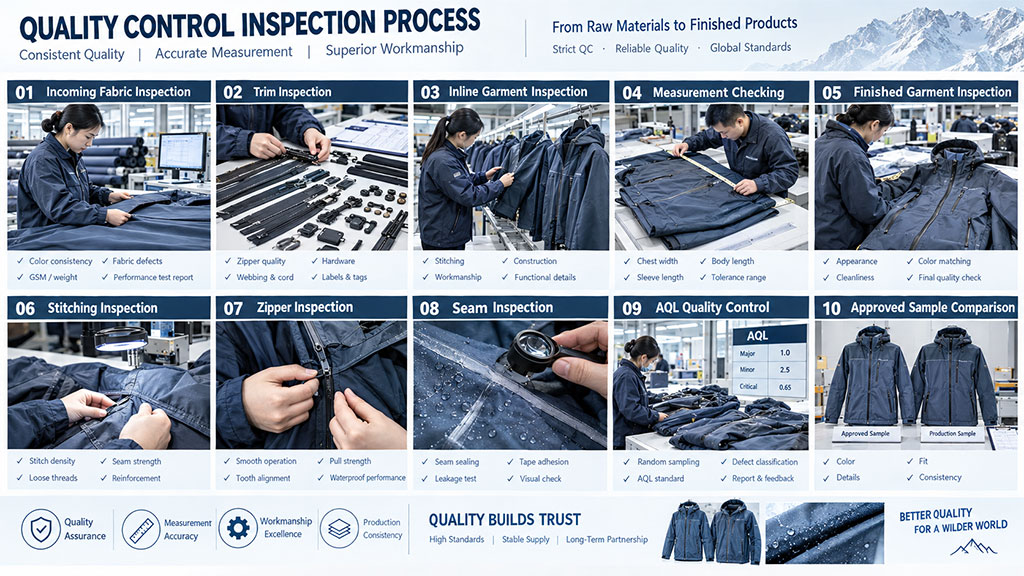
10. Control Quality Throughout Production
Quality control should not begin only after finished garments leave the production line.
A stronger approach is to control quality throughout manufacturing.
Incoming Material Inspection
Fabric, trims, labels, zippers, and other components are checked before production begins.
Inline Inspection
Garments are inspected during production to identify recurring construction, workmanship, or measurement problems.
Finished Garment Inspection
Completed garments are checked against approved samples, measurements, appearance, construction, and customer requirements.
AQL Inspection
For applicable production orders, statistical sampling can be used to evaluate whether the production lot meets the agreed acceptance criteria.
This creates a direct connection between the approved development specifications and actual bulk production quality.
11. Complete Final Approval and Shipment
Before shipment, finished garments should be evaluated against the approved production standard.
Key checks may include:
- Measurements
- Fabric appearance
- Color consistency
- Stitching
- Seam construction
- Zippers
- Labels
- Logo placement
- Functional components
- Packaging
- Quantity
For technical outdoor apparel, product-specific functional requirements should also be verified where applicable.
The objective is straightforward:
The bulk product should match the approved production standard.
The Complete Outdoor Apparel Development Process
The entire journey can be summarized as:
Concept
Define the product, market, performance requirements, target cost, and production objectives.
↓
Technical Development
Create the tech pack, measurements, material specifications, and construction requirements.
↓
Material Development
Select and test fabrics, trims, membranes, insulation, zippers, and other components.
↓
Prototype
Develop the first physical sample to validate design and construction.
↓
Fit & Revision
Evaluate measurements, mobility, construction, appearance, and functionality.
↓
Performance Testing
Verify required technical performance through appropriate testing.
↓
PPS Approval
Finalize the production-ready sample and technical specifications.
↓
Bulk Production
Translate approved specifications into repeatable manufacturing processes.
↓
QC & Inspection
Monitor materials, production, measurements, workmanship, and finished-garment quality.
↓
Shipment
Complete final approval, packing, documentation, and delivery.
Why Structured Outdoor Apparel Development Matters for B2B Brands
For growing B2B apparel brands, the value of a structured development process goes beyond producing one successful garment. A documented development system creates repeatability. Once specifications, patterns, materials, measurements, construction details, and QC standards have been approved, these references can be used for future production runs. This can help reduce:- Sampling errors
- Communication gaps
- Production inconsistencies
- Material mistakes
- Quality disputes
- Unplanned revisions
- Development delays
How Simmerui Supports Outdoor Apparel Development
Simmerui Apparel Development Team supports B2B brands through the product development stages that connect concept requirements with production-ready specifications.
The development process can include technical specification review, material development, pattern and prototype development, sample revision, performance testing coordination, PPS approval, and preparation for bulk manufacturing.
Simmerui Apparel Manufacturing Team then connects the approved product with fabric sourcing, production planning, quality control, and scalable OEM/ODM manufacturing.
The objective is not simply to produce a prototype.
It is to help establish a repeatable manufacturing standard that can move from development into reliable commercial production.
FAQ: Outdoor Apparel Development and OEM Manufacturing
1.What is outdoor apparel development?
Outdoor apparel development is the process of converting an outdoor clothing concept into a production-ready garment through material selection, technical specification, pattern development, sampling, fitting, testing, approval, and manufacturing.
2.What is the difference between a prototype and a PPS?
A prototype is an early development sample used to evaluate design, fit, and construction. A PPS, or Pre-Production Sample, is the approved sample intended to represent the final bulk production standard.
3.Why does outdoor apparel require multiple samples?
Technical outdoor garments often contain more components, construction details, and performance requirements than basic apparel. Waterproof shells, insulated jackets, and multi-layer garments may therefore require several rounds of prototype, fit, revision, and approval.
4.What tests are commonly used for outdoor apparel?
Depending on product requirements, common tests include waterproofness, hydrostatic pressure, breathability, MVTR, RET, abrasion resistance, tensile strength, tear strength, colorfastness, shrinkage, and seam performance.
5.Should fabric be tested before bulk production?
Yes. Fabric performance should be verified against the requirements of the final product before committing to large-scale production. For technical apparel, garment-level testing may also be necessary.
6.What should a PPS sample include?
A PPS should represent the approved bulk production standard, including specified materials, color, pattern, measurements, construction, trims, branding, stitching, functional details, and finishing requirements.
7.How can brands reduce outdoor apparel development time?
Better preparation is usually more effective than simply trying to make sampling faster. A clear tech pack, complete measurement specifications, defined material requirements, consolidated feedback, and timely approvals can reduce unnecessary development cycles.
8.Can outdoor apparel be customized for different brands?
Yes. OEM and ODM manufacturers can customize fabrics, colors, patterns, measurements, trims, labels, logos, construction details, and functional features according to brand requirements.
9.How does OEM manufacturing support outdoor apparel brands?
OEM manufacturing allows brands to develop products according to their own specifications while using the manufacturer’s capabilities for material sourcing, pattern development, sampling, production, quality control, and bulk manufacturing.
Conclusion: From Outdoor Apparel Prototype to Scalable Production
Successful outdoor apparel development is not simply a journey from a sketch to a finished garment.
It is a controlled progression:
Product Concept → Technical Specification → Material Selection → Prototype → Fit → Testing → PPS → Bulk Production → QC
For B2B outdoor brands, the ultimate goal is to create a product that is not only visually correct, but also technically validated, commercially viable, production-ready, and repeatable at scale.
A capable OEM/ODM manufacturing partner can connect product development with fabric sourcing, sampling, testing, production planning, quality control, and bulk manufacturing—reducing the gap between the first prototype and successful commercial production.
Written by the Simmerui Apparel Manufacturing Team
Simmerui provides OEM and ODM apparel manufacturing solutions for global B2B brands, connecting product development, fabric sourcing, sampling, quality control, and scalable production across outdoor apparel, performance wear, casual clothing, and private-label collections.